

Our review
 Analysis by Lookingapps
When I judge a money app, I care less about how many tools it advertises than about whether it can handle the ordinary jobs I actually have: paying someone back, keeping spending separate, or checking an investment without turning a quick task into a project. Cash App is built around that kind of convenient, mobile-first money management. I’d consider it when I want several financial activities in one place, but I would not treat it as an automatic replacement for every bank or investing service I use.
Choosing it for the way you handle money
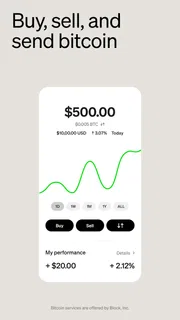
Cash App is a free finance app from Block, Inc. It brings together person-to-person payments with banking and investing tools, including bitcoin. That range is its main appeal: instead of keeping every money-related task in a different app, I can start with a simple payment and use the same app for other financial activities when they suit my needs.
The most useful question is whether that combination matches your habits. If you often split everyday costs with friends or family and also want access to additional money tools, Cash App is easier to justify than an app intended only for one narrow task. If you mainly need a full-service bank relationship, detailed investment research, or a dedicated bitcoin platform, a specialist may be a better fit. A broad feature set is convenient, but it does not make every part of the app the best option for every person.
For a concrete example, imagine that I share a meal with a friend who has covered the bill. I can use a payment app to settle my part, then return to Cash App later if I want to review my finances or explore its investing options. The practical benefit is having fewer separate places to remember. The trade-off is that I need to be deliberate about which features I use, rather than assuming that convenience alone makes each one right for me.
The app has a 4.7 average from around 4.5 million ratings, and it has been installed over 100 million times. Those figures suggest that it has broad reach and that many people find the basic proposition useful. They don’t tell me whether it will fit a particular household’s routines, so I’d still judge it by the tasks I expect to perform and the financial services I already rely on.
Where the all-in-one approach helps
Cash App is strongest when a quick payment is only one part of a broader mobile money routine. Having payments, banking-related tools, investing, and bitcoin in the same app can reduce the small bits of friction that come from switching between services. I find that especially appealing for people who want a straightforward entry point rather than a collection of separate apps with different interfaces.
There is also a useful decision-making advantage in keeping related activities visible together: it can make the app feel like a practical hub rather than a single-purpose wallet. Still, I would avoid blurring categories in my own mind. A payment feature, a banking tool, a stock investment, and bitcoin each serve different purposes and carry different considerations. I’d use the app’s breadth as a convenience, not as a reason to combine money I need for bills with money I’m willing to invest.
More articles

Instagram Makes Everyday Moments Worth Sharing
A rare social app that can be a photo diary, a neighborhood window, and a lively conversation in the same session—though its best moments still require a little restraint.
A good personal workflow is to decide in advance what role the app will play. For instance, I might use it for informal payments and explore its other tools separately, while continuing to use my existing bank for core financial needs. That boundary makes it easier to benefit from convenience without moving every financial decision into one place just because the option is available.
One subtle strength of a multi-purpose app is that it can make small financial tasks easier to revisit. If I send money to someone, I am already in the right environment to check what else the app offers. But that same ease can encourage casual exploration of investing features. I’d treat those as deliberate decisions: take time to understand what I’m doing, rather than making an investment choice in the middle of a routine payment.
Payments work best when expectations are clear
For everyday use, a payment app is most helpful when both people know which service they’re using and are comfortable with it. Before relying on Cash App for a time-sensitive shared expense, I’d make sure the recipient is able to use the same service and confirm the payment details carefully. That is a simple habit, but it matters more than the speed or polish of an interface when money is involved.
I also wouldn’t assume that a person-to-person payment behaves like handing over cash. Digital transfers are easy to initiate, which is exactly why checking the recipient and amount before sending is worthwhile. My practical rule is to slow down for the final confirmation, especially when I’m paying someone I don’t know well or responding to an unexpected request. Convenience should make legitimate exchanges smoother, not remove common-sense caution.
Cash App’s breadth is helpful, but it can mean the experience is less focused than a payment-only tool. Someone who wants nothing beyond occasional transfers may prefer a simpler option already used by their contacts. In that case, the best choice is often the service that fits the group’s normal habits, not the one with the longest menu of financial features.
When a specialist or existing bank is the better choice
If I need a primary place for all my banking, I would compare Cash App with established banking options based on the services and protections I personally need. The word “banking” in an app’s feature mix should not lead me to assume that every account, service, or institution works identically. I’d read the relevant terms in the app and decide whether they meet my needs before moving direct deposits, bill payments, or emergency savings into a new setup.
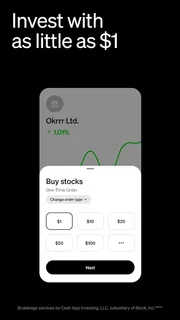
Investing is another area where a specialist may suit me better. Cash App can be appealing if I want investing access alongside everyday money tools, but a dedicated brokerage may be preferable if I depend on extensive research, advanced controls, or a more specialized workflow. The right comparison is not simply how many features each app has; it is whether the available tools match the kind of decisions I make and how much guidance I want.
The same distinction applies to bitcoin. Having access to bitcoin in a general finance app can be convenient for someone who wants it as one optional part of their money routine. If I’m deeply involved in cryptocurrency, I’d compare dedicated services and carefully consider how I want to manage that activity. I would not choose a product just because it makes a complex asset easy to reach; ease of access and suitability are separate questions.
People who value a single, familiar relationship with a traditional financial institution may also prefer to keep their everyday money there and use Cash App only for specific tasks. That is not a failure to take advantage of the app. It can be a sensible division of responsibilities: use a mobile payment service where it helps, and keep core banking or specialized investing with the provider that best fits those needs.
What to check before making it part of your routine
Cash App is free to download and use as an app, but I would not interpret that as a promise that every financial activity has no cost or the same terms. Before using a particular service, I’d review the details presented for that feature, including any applicable costs and conditions. This is especially important when comparing an investment or bitcoin transaction with a dedicated alternative, because the overall experience and terms can differ.
I’d also make account security part of the setup rather than an afterthought. Use the security options available in the app, protect access to the phone and account, and be cautious about messages that pressure you to send money or share sensitive details. For a payment app, good personal habits are an important part of using it responsibly; no convenient interface can replace careful handling of account access and payment requests.
Another useful tip is to keep a note of which financial tasks you have actually moved into the app. If I use it only for occasional payments, there is little reason to change other accounts. If I begin using its other tools, I’d review that arrangement periodically and make sure I still understand where my money is held, what each feature does, and which provider I should contact for a particular issue.
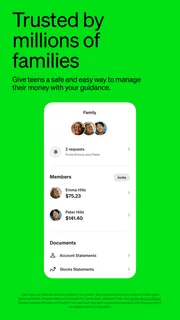
The app is rated for Everyone, but that audience label does not mean every financial feature is suitable for every age or situation. I’d check the rules and requirements for the specific service I plan to use, especially before involving a young person or making an investment. An age classification is useful context for the app as a whole, not a substitute for understanding the conditions attached to individual financial activities.
Switching is easy to start, not always wise to rush
Trying Cash App for a limited purpose is less disruptive than moving an entire financial life at once. I’d begin with the task that prompted me to look for it—perhaps paying a friend—then decide whether its other features genuinely make my routine easier. This staged approach gives me a chance to learn the interface and the boundaries of each service before I depend on it for something more important.
If I already use another payment app, the main switching cost may be social rather than technical: the people I exchange money with may prefer a different service. Before changing my habits, I’d ask whether the people I pay can use Cash App comfortably. If they cannot, keeping the existing option may save more effort than adopting a new app for the sake of consolidation.
Moving core banking or investment activity deserves more care. I would not close an existing account or redirect important payments simply because Cash App offers related features. First, I’d confirm that the new arrangement supports the tasks I depend on, understand the applicable terms, and keep a reliable way to manage essential expenses during any transition. Convenience is a good reason to try an app; it is not, by itself, a reason to make a rushed financial switch.
Who I’d recommend it to
I’d recommend Cash App to someone who wants a familiar mobile place for sending money and values having additional finance tools close at hand. It is especially sensible for people whose friends or family already use it and who prefer to handle informal payments without juggling several apps. Its popularity is substantial, with around 481,000 written reviews, but I’d still base my choice on the people I transact with and the specific tools I plan to use.
I’d be more cautious if I needed one dependable home for every financial need, wanted highly specialized investing or bitcoin capabilities, or preferred to keep payments and investments entirely separate. In those cases, a bank, brokerage, or dedicated payment service may offer a better fit for the particular job. Cash App’s strength is convenience across several kinds of money activity, not a guarantee that it replaces specialist services.
The app was released on October 15, 2013, and its current version is 5.74.0; it requires Android 10 or later. Those details are useful when checking whether a device can run it, while the fact that it is free and broadly available makes trying it a relatively simple first step. I’d still check the app store for compatibility with my own device before installing.
My overall view is that Cash App is worth considering when its combination of payments and other financial tools matches your actual routine. I like the idea of starting with a simple, everyday task and using the broader features only when they make sense. If you keep clear boundaries between spending, banking, and investing—and compare specialist alternatives where your needs are more demanding—it can be a useful addition. If you only need one focused service, or want a traditional institution to handle your core finances, choosing a narrower option may be the smarter decision.
Pros
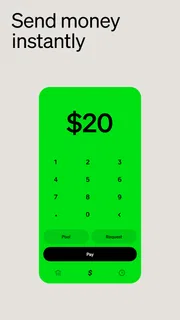
- Send money to other Cash App users with a $Cashtag
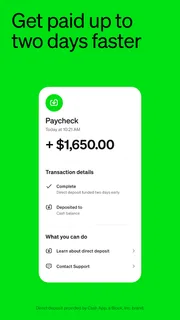
- Set up direct deposit for eligible paychecks
- Use a customizable debit card for purchases
- Buy and sell Bitcoin within the app
- Track spending with a searchable transaction history
Cons
- Some transfers may take several days unless you pay a fee
- Instant deposits can incur a fee
- Bitcoin services are not available in every location
- Customer support options may be limited for some issues
- Using a Cash Card requires approval and identity verification


