
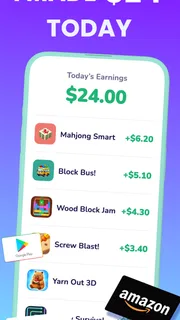



Our review
 Analysis by Lookingapps
I’d consider Playout: Earn Money if I wanted a lifestyle app that adds a reward angle to activities already in my routine. The key question is what I expect “earn extra money” to mean: a small incentive that makes everyday habits feel more engaging, or a dependable source of income. I’d approach it as the former, not the latter. That distinction matters more than the promise of rewards, because an app like this is only worthwhile if using it feels convenient and the payoff seems proportionate to the time involved.
Decide what kind of reward fits your routine
Playout is a free lifestyle app from Loyalty Gaming, with a mature 17+ age rating. Its brief store description points toward getting rewarded for things you already do, alongside an element of fun. That makes it a different proposition from a conventional budgeting tool, a paid survey service, or a game whose main purpose is entertainment. I’d choose it for a little extra motivation, rather than to track spending or replace a regular income stream.
Before installing, I’d ask myself whether I’m comfortable exploring a rewards app and checking its terms as I go. In this category, the practical value depends not just on earning opportunities but on how clearly the app explains eligibility, progress, and redemption. I wouldn’t assume that every ordinary activity automatically qualifies or that a reward arrives immediately. The useful test is whether the opportunities actually fit my habits without leading me to spend more time or money than I intended.
The app has a 4.6 average from around 58,000 ratings, and more than 1 million installs. Those figures suggest that many people have tried it and that its reception is generally positive, but they don’t tell me whether it will suit my routine. I’d treat ratings as a reason to take a closer look, not as a guarantee of a particular earning experience. Individual results with reward-based apps can depend on what is available and what a person is willing to do.
My main decision rule is simple: use it only for activities you would have done anyway. If an offer nudges me into an unnecessary purchase, a long session, or a habit I don’t enjoy, the reward has stopped being a bonus. This is especially important when comparing reward apps with straightforward cashback or a savings tracker, where the value may be easier to calculate and the experience less game-like.
How I’d judge whether it is worth keeping
I’d give the app a fair trial by opening it at a natural point in my day, rather than repeatedly checking it in search of something to do. I’d look for opportunities that match an existing routine and note what the app asks me to complete before counting a reward as earned. That small check helps separate a genuinely low-effort bonus from an offer that only looks appealing at first glance.
For example, imagine I’m already relaxing with my phone after dinner. I could check whether Playout has something suitable for that window, then decide whether it is more enjoyable than what I would normally do. If participation requires extra steps or keeps me engaged longer than I planned, I’d stop and return to my usual activity. The app should fit into spare time; spare time shouldn’t become an obligation to the app.
More articles

Instagram Makes Everyday Moments Worth Sharing
A rare social app that can be a photo diary, a neighborhood window, and a lively conversation in the same session—though its best moments still require a little restraint.
A second useful habit is to review the terms of an opportunity before starting it, especially if it involves spending, a deadline, or a particular completion condition. I’d also make a note of what counts as finished and where the app shows progress. This prevents a common frustration with rewards products: assuming that simply opening or trying something is enough when the actual requirement may be more specific.
Where Playout has the strongest appeal
The strongest case for Playout is its mix of lifestyle framing and rewards. Someone who enjoys turning ordinary phone time into a small challenge may find that more appealing than a plain list of coupons. The app’s focus is also easy to understand: it aims to make familiar behavior feel more rewarding, rather than asking the user to adopt a completely different purpose for their phone.
That can be a good fit for people who already browse or play on their device and would enjoy having a reward-oriented reason to explore. I’d also consider it for a person who likes trying new apps but wants a possible benefit attached to that curiosity. The important caveat is that the entertainment value should stand on its own. If the activity feels tedious without the reward, I wouldn’t assume the reward will make it worthwhile.
Its free price makes trying it less of a financial commitment than an app with an upfront purchase. Still, “free” doesn’t mean there is no cost at all: time, attention, and any spending attached to an offer are real costs. I’d keep those in view and avoid treating a displayed reward as equivalent to cash already received. The app’s appeal is the chance of a useful extra, not a substitute for a predictable paycheck.
Loyalty Gaming’s app is on version 1.17 and requires Android 7.0 or later. That gives Android users a straightforward compatibility check before they install. The age rating is another practical filter: it is marked for mature audiences, so it is not a suitable choice for younger users. I’d check the device’s store page before downloading to ensure the current listing matches my phone and account.
When another kind of app is the better choice
If my priority were to earn through tasks with clearly stated compensation, I’d compare Playout with established task or survey apps and read their completion rules closely. If I mainly wanted savings on purchases I already planned, a cashback or coupon app would be a more direct match. And if I wanted to relax without tracking rewards, an ordinary game would be simpler. These alternatives serve different goals, so I wouldn’t judge them solely by which one sounds most generous.
Playout may not suit someone who dislikes promotional experiences, prefers a transparent fixed rate for time spent, or wants income they can budget around. It may also be the wrong fit for someone who finds reward counters distracting or tends to keep using an app just to reach a target. In those cases, a conventional entertainment app or a simple finance tool could provide a better experience, even without the same incentive framing.
I’d be cautious, too, if I were installing it only because I need money urgently. Reward apps are generally better approached as incidental extras than as solutions to an immediate financial problem. A more dependable option—such as paid work, a benefits service, or a budgeting resource—would be a wiser place to start if the need is essential. Playout is best evaluated as an optional activity, not a financial plan.
What to check before making it part of your day
The biggest practical question is how rewards work for the opportunities shown to me. I’d read the in-app explanation before investing time, confirm what action completes an offer, and check any conditions attached to claiming a reward. I’d also look at whether the available activities are relevant to my interests. If the options don’t match what I’d willingly do, there is little reason to keep checking back.
I’d make the first session an information-gathering visit, not a commitment. Browse the available choices, identify any requirements, and decide whether one fits a real gap in the day. If an activity needs more attention than I want to give, skip it. This approach is more useful than chasing every visible opportunity, because it protects the app’s role as an optional bonus rather than allowing it to dictate how I use my phone.
Another trade-off is that rewards can make low-value activity feel more valuable than it is. I’d judge each opportunity by the full experience: time required, any expense, and whether I would choose the activity without an incentive. That comparison is especially useful when deciding between Playout and alternatives. A small reward for something enjoyable may feel worthwhile; the same reward for something inconvenient may not.
My recommendation after weighing the trade-offs
I’d recommend Playout to adults who are curious about reward-based phone experiences, enjoy a playful nudge, and are comfortable treating any benefit as incidental. Its free entry point and positive overall reception make it reasonable to explore, while its lifestyle focus gives it a clearer purpose than a generic game. I would still start with modest expectations and make sure the activities fit naturally into time I already have available.
I’d skip it if I needed reliable income, wanted a simple way to reduce planned shopping costs, or preferred to know exactly what each minute of effort was worth before beginning. Those goals call for different tools. I’d also avoid encouraging a younger user to install it, given its mature age rating.
For me, the right way to use Playout: Earn Money is as an optional extra: check it when convenient, choose only opportunities that make sense, and stop when the time or effort outweighs the appeal. If that mindset matches yours, it may be worth trying. If the reward promise is the only reason an activity seems attractive, I’d choose something else and keep my routine simple.
Pros
- Simple tasks make it easy to get started.
- A variety of activities can keep the experience fresh.
- The app offers a way to earn rewards in spare time.
- Progress tracking helps you monitor completed tasks.
- The interface is designed for quick navigation.
Cons
- Earnings may be small compared with the time spent.
- Reward availability can vary by location.
- Some offers may require purchases or subscriptions.
- Payouts may have minimum thresholds or processing delays.
- Users may need to share personal data to qualify for offers.


