
Our review
 Analysis by Lookingapps
I like word puzzles best when they give my mind something to do without demanding a long, focused session. Word Connect Association is built around that small-pocket-of-time appeal: you link related words, look for connections, and settle into a calm puzzle rhythm. It is a free word game from PlaySimple Games, and its simple premise makes it easy to understand before you decide whether its style suits you.
A quiet first impression
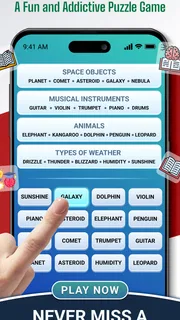
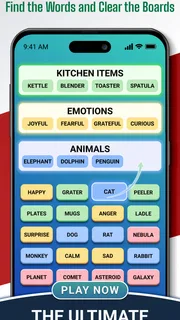
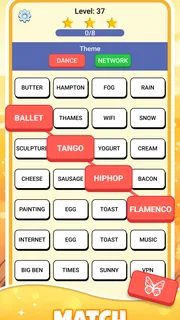
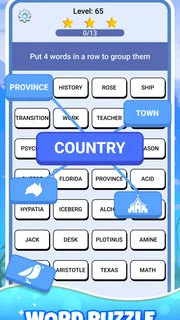
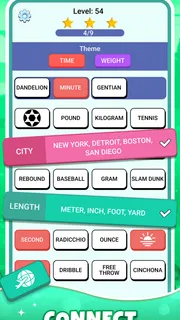
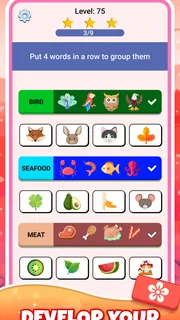
The game’s central pleasure is the moment a loose collection of words begins to feel connected. Instead of treating every word as an isolated answer, I’m encouraged to think about associations: what belongs together, what suggests the same idea, and which connection might be less obvious than the first one that comes to mind. That gives the familiar word-puzzle format a more interpretive feel.
It is the kind of game I can imagine opening while waiting for a kettle to boil or taking a short break between tasks. A puzzle can give that pause a little structure without turning it into a commitment. The store summary describes a calming experience, and that is a sensible way to approach it: the appeal is a relaxed mental nudge, not a high-pressure contest.
Word Connect Association is listed as a word game for Everyone. It launched on July 7, 2025, and version 1.70.0 requires Android 8.0 or later. Those details make it straightforward to assess whether it fits an Android device, while the accessible age rating reflects the broad, language-based nature of the experience.
Words do the world-building
There is no need for an elaborate fictional setting to make this kind of puzzle work. Here, the world is largely made from language itself: words acquire meaning through their neighbors, and the player supplies the associations that turn a set of terms into a pattern. I find that restraint appropriate. It keeps attention on the task rather than asking me to learn a separate story or theme before I can enjoy a round.
That also means the game’s personality depends heavily on how its words invite thought. A strong association puzzle gives me more than one plausible route into a problem, then rewards me for noticing the connection that best fits the group. The useful habit is to pause before committing to the first obvious match. I often get further by naming a broad theme in my head—an activity, a place, a quality, or a shared context—then checking whether each word genuinely belongs.
One practical trick is to sort mentally rather than guess rapidly. If two words seem connected, I hold them as a tentative pair and look for a third term that strengthens or weakens that idea. This helps distinguish a real relationship from a coincidence, especially when words have several meanings. It is a small change in approach, but it makes the puzzle feel more like reasoning and less like trying combinations at random.
More articles

Instagram Makes Everyday Moments Worth Sharing
A rare social app that can be a photo diary, a neighborhood window, and a lively conversation in the same session—though its best moments still require a little restraint.
The trade-off is that association is subjective. People bring different vocabulary, cultural references, and personal experiences to a word, so a connection that feels natural to one player may not be the first one another person sees. I would not recommend treating every difficult puzzle as a test of intelligence; sometimes the challenge is simply recognizing the intended framing. If that kind of ambiguity irritates you, a crossword with clear clues or a spelling puzzle with a single obvious target may feel fairer.
Calm pacing, with room for a sharper challenge
The format suits brief sessions because the thinking can happen in small steps: inspect the words, form a possible relationship, and reconsider if the group does not quite hold together. That gentle loop gives the game its relaxing side. It is a better fit for winding down or filling a gap than for someone seeking fast reactions, elaborate strategy, or a dramatic competitive arc.
For a more useful everyday routine, I’d play one puzzle when I want a screen break that still feels mentally active, rather than opening it while I need to concentrate on a demanding task. Word association can draw attention into a chain of ideas, and that is the point—but it also means the game is not necessarily ideal when I only have a few distracted seconds. A short, undisturbed pause is more rewarding than repeatedly checking the screen while juggling other things.
Its calm tone should not be mistaken for a guarantee that every puzzle will feel effortless. Familiar words can still produce a stubborn grouping, and the more associations a word has, the more possible paths it can suggest. When I stall, I find it helpful to stop searching for a clever answer and instead ask what the words have in common in ordinary conversation. That reset can reveal a plain connection that overthinking had buried.
The game’s mood also depends on the player. Someone who enjoys a quiet focus exercise may find the measured pace comforting; someone who wants constant novelty or escalating urgency may find it too subdued. I see that as a clear design trade-off rather than a flaw on its own: the emphasis is on noticing relationships, not on keeping the player keyed up.
How the mechanics compare with other word games
Compared with crosswords, this style puts less weight on retrieving a specific answer from a clue and more on judging how words relate. Compared with word-search games, it asks for interpretation rather than simply scanning a grid for letter sequences. And compared with spelling or letter-building puzzles, it is less about constructing a word and more about understanding a group of words together. That difference is the main reason to choose it over the usual alternatives.
It is particularly appealing if you like lateral thinking but do not want a puzzle that requires specialist knowledge or a lengthy setup. It can also work well as a shared activity: one person can suggest a category while another challenges whether every word fits. That informal approach turns a solo puzzle into a conversation without needing to make the game itself more complicated.
There is a limit to that flexibility. Players who prefer strict rules, a clearly measurable skill curve, or a single unambiguous solution may find association-based puzzles less satisfying than logic grids or clue-led games. Likewise, if your favorite word games are about vocabulary drills or spelling practice, this format may feel too focused on conceptual links. I would choose it for a change of mental gear, not as a replacement for every kind of word puzzle.
One useful way to keep sessions enjoyable is to alternate between quick first impressions and a deliberate second pass. On the first pass, I notice the obvious links. On the second, I look for a relationship that can account for the less obvious terms too. That simple two-stage method reduces impulsive guesses and makes the eventual connection feel earned, while still preserving the relaxed pace.
Value, audience, and practical expectations
The game is free to install, with in-app purchases listed from $0.99 to $199.99 per item. I would treat the free entry point as a chance to find out whether this particular kind of association puzzle holds my attention, and make any purchase decision only after checking the purchase details in the app store. The range is broad, so it is worth being deliberate rather than assuming every optional item costs the same.
Its audience is easy to picture: casual puzzle fans, people who enjoy making connections between everyday words, and anyone looking for a low-key activity during a break. PlaySimple Games has a substantial audience for this title, with over a million installs, an average rating of 4.8 from around 43,000 ratings, and roughly 2,200 written reviews. Those figures suggest that many players have found the format appealing, though they cannot tell me whether its style will match your personal taste.
The main question is whether you enjoy open-ended word relationships more than tightly defined clues. If you do, the game’s premise is immediately inviting. If you need every puzzle to offer one unmistakable route to an answer, I would look first at a more structured crossword or logic game. That distinction is more useful than judging it by the broad label of “word game,” which covers very different kinds of play.
Where its atmosphere succeeds—and where it may not
Word Connect Association’s strongest mood comes from the calm relationship between its premise and its pace. The player is asked to notice, compare, and connect, so a restrained presentation makes sense: the words remain the center of attention, and the activity can fit into an ordinary day without needing a grand narrative frame. I appreciate that coherence. The mood supports the mechanic rather than competing with it.
That same focus places limits on what the experience can offer. If you want a richly developed setting, a story to follow, or a game that changes its basic rhythm dramatically, this is unlikely to be your best choice. Its appeal is narrower and more specific: a brief, thoughtful word challenge built around associations. I would also skip it if you find subjective connections frustrating or if you prefer puzzles where every answer can be checked against a sharply defined clue.
For me, Word Connect Association is most recommendable as a modest daily pause: open it when you have a little attention to spare, think through the links, and stop when the moment is over. It is not trying to replace every crossword, word search, or spelling game. Instead, it offers a calmer alternative for players who enjoy seeing how ordinary words can fit together in surprising ways.
Pros
- Quick rounds make it easy to play during short breaks.
- Word puzzles offer a relaxing way to exercise vocabulary.
- Simple controls are easy for new players to understand.
- Progressive challenges provide a steady sense of advancement.
- Offline play is useful when an internet connection is unavailable.
Cons
- Later levels can feel repetitive.
- Some word associations may seem subjective.
- Hints can reduce the challenge of solving puzzles unaided.
- Small screens may make longer sessions tiring.
- Ads may interrupt the flow of play.


