
Our review
 Analysis by Lookingapps
I see Melon Sandbox as a digital toy box first and a conventional game second. Its central appeal is the freedom to set up playful experiments with characters, objects, and physics, then watch the scene unfold. That open-ended approach makes it easy to dip into for a few minutes, but it also means the fun depends more on your own ideas than on being guided through a campaign. If you enjoy making a small mess just to see what happens, that is a real strength; if you want a clear goal and steady progression, it may feel loose.
Building a scene is the main event
The game belongs to the simulation genre, though “sandbox” describes its feel more accurately than a realistic simulator would. I found the most satisfying loop in arranging a scene, introducing a bit of chaos, and changing the setup when the result was funny, surprising, or simply not what I expected. The pleasure is in the cause and effect: a small change to the arrangement can produce a very different little spectacle.
That makes the game a better fit for improvising than for following instructions. There is no need to treat each session as a task you must complete. I can open it with a vague idea—make a scene that looks dramatic, test how a setup behaves, or build something silly—and let the play develop from there. The experience rewards curiosity, but it does not automatically supply a purpose when I arrive without one.
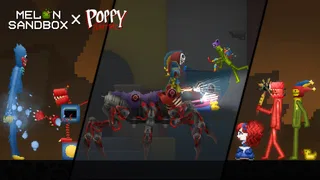
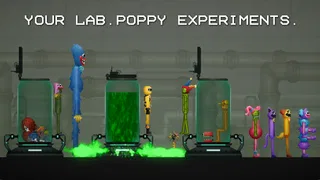
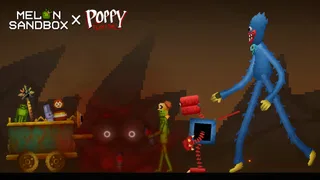
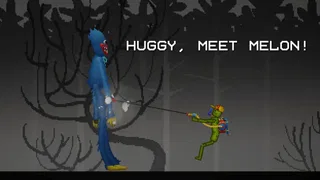
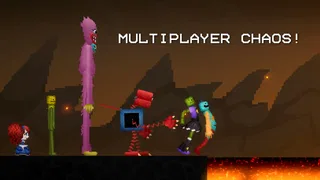
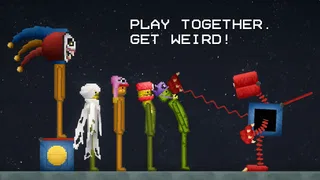
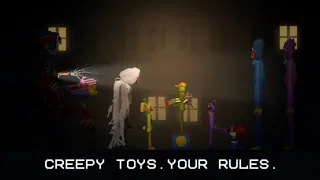
The Halloween collaboration with Poppy Playtime is a themed addition to that basic appeal, with exclusive mods as part of the crossover. It gives fans a recognizable seasonal flavor to explore, while the broader draw remains the freedom to create and experiment. I would approach the collaboration as an extra reason to revisit the sandbox, not assume that it changes the game into a story-driven horror adventure.
Why the open-ended format works
Many mobile simulations are built around managing resources, completing jobs, or steadily unlocking a larger system. This one leans toward hands-on play: you decide what to place together and what kind of outcome you want to see. That difference matters. It makes the game more immediate than a long management sim, but less structured than a level-based puzzle game that tells you exactly what to solve.
I also like that a scene can be treated as a rough experiment rather than a polished creation. If the setup goes wrong, that failure can be the entertaining part. The freedom lowers the pressure to get everything right, but it also shifts the burden of invention onto the player. The most enjoyable sessions are the ones where I arrive with a small question or a playful premise instead of expecting the game to entertain me on autopilot.
Turning a vague idea into a good session
A useful way to start is to give yourself one simple constraint. For example, decide that you will build a scene around one character, one prop, or one visual gag, then see how much you can do with it. This keeps the open space from becoming overwhelming and gives the session a loose shape without imposing a formal objective. Once something interesting happens, adjust one element at a time. That makes it easier to understand what changed the outcome instead of randomly rebuilding everything.
More articles

Instagram Makes Everyday Moments Worth Sharing
A rare social app that can be a photo diary, a neighborhood window, and a lively conversation in the same session—though its best moments still require a little restraint.
Another practical habit is to think in short rounds: set up, observe, revise. If the first attempt is dull, make one deliberate change and run it again. In a physics sandbox, that small, controlled revision is often more satisfying than piling on extra objects. It turns “messing around” into a simple creative process, and it helps players who are new to the format discover their own ideas without needing a tutorial-like goal.
For a casual evening break, I would use it as a quick creative reset. After finishing a few everyday tasks, I might spend a short session staging an absurd scene and seeing whether it works. That is a more realistic use than expecting a single play session to deliver a complete narrative or a deep progression arc. The game is strongest when I can stop after one amusing result and return later with a new experiment.
Where the freedom has limits
The same lack of prescribed goals that makes the sandbox inviting can leave it feeling aimless. Players who enjoy clear missions, a campaign to finish, or a steady sense of achievement may not find enough direction here. It is possible to open the game and wonder what to do next, especially if you are not naturally inclined to invent scenarios. In that case, a mission-based simulation or a puzzle game may be a better match.
There is also a difference between freedom and depth. A broad set of things to try does not necessarily mean every player will find a long-term challenge in it. Once you have repeated your favorite kind of setup, you may need to deliberately change your approach to keep it fresh. I would not recommend it as a substitute for a carefully authored adventure if what you want is character development, a plotted sequence of events, or a clear finish line.
The game is free to start, but it includes in-app purchases ranging from $0.49 to $259.99 per item. That is a wide span, so I would be cautious about tapping through purchase screens casually, especially if a younger player uses the device. The free entry point is appealing, but the presence of optional purchases means it is sensible to check the store prompts and device purchase controls before handing the game over.
Its Teen content rating is another useful point for families to consider. I would not treat the simple, playful presentation as a reason to ignore the rating; parents should make their own judgment about whether the game’s style and content suit a particular child. The game is not aimed at every age simply because it is easy to pick up, and the crossover theme may be more appealing to players already familiar with its characters.
How it compares with other mobile simulations
Compared with a city builder or a life simulator, this is less about maintaining a system and more about making something happen in the moment. You are not choosing it for careful long-range planning. Compared with a physics puzzle, it offers a looser experience rather than a sequence of designed problems with one intended solution. That puts it in a particular niche: players who like playful experimentation may prefer it, while players who want tidy objectives may be happier elsewhere.
It also differs from a standard action game because the satisfaction comes from setting up the situation, not simply reacting to a stream of enemies or levels. That can make it a good change of pace for someone who usually plays goal-focused games. On the other hand, anyone who wants competitive matches, a guided story, or a predictable reward loop should look for a different kind of mobile game. The sandbox’s appeal is personal authorship, not a universal checklist of accomplishments.
Who is likely to get the most from it
I would recommend it most to players who like tinkering, improvising, and laughing at unintended outcomes. It can also suit someone who wants a game that does not demand a long uninterrupted session: you can make one small scene, see what happens, and put it down. The Halloween and Poppy Playtime collaboration adds a point of interest for fans, while the underlying sandbox remains the main reason to keep playing.
By contrast, I would suggest skipping it if open-ended play feels like homework, if you need a clear objective every time you launch a game, or if you are looking for a realistic simulation with detailed rules. It is also not the ideal pick for anyone who wants to avoid in-app purchase prompts entirely. Choosing it with those expectations in mind makes the difference between enjoying its freedom and feeling that it has not given you enough direction.
There is a reason the game has reached over 100 million installs and has a 4.7 average from around 1.4 million ratings, alongside about 55,000 written reviews. Those figures suggest a large audience for its particular style, though they do not guarantee that every player will enjoy an unstructured sandbox. It is developed by playducky.com, is free, and was released on December 23, 2022; it currently lists version 38.666 and requires Android 7.1 or later.
Overall, I think Melon Sandbox is worth trying if the idea of creating a scene and seeing how it behaves sounds more fun than completing a mission. Its best quality is the room it gives you to experiment, and its biggest weakness is that the player must supply much of the direction. Go in with a small idea, change one thing at a time, and treat unexpected results as part of the entertainment. If you want a guided game, choose something more structured; if you enjoy making your own little experiments, this sandbox gives you a relaxed place to do it.
Pros
- Creative tools let you build custom scenes and experiments.
- A large selection of objects supports varied sandbox scenarios.
- Simple controls make it easy to start experimenting.
- Offline play is available for casual sessions.
- Frequent updates can add fresh content and improvements.
Cons
- Ads may interrupt play or appear between sessions.
- Some items and features may require in-app purchases.
- Physics can behave unpredictably during complex experiments.
- Performance may slow down on older devices.
- The open-ended gameplay may feel aimless without personal goals.


