
Our review
 Analysis by Lookingapps
I came to Brain Test: Tricky Puzzles expecting a familiar kind of trivia game: read a question, pick an answer, and move on. It quickly showed me that the real challenge is noticing when a question is trying to steer me toward the obvious choice. This free brain puzzle game from Unico Studio is built around playful, unexpected problems, making it a good fit when I want a quick mental workout rather than a long, complicated gaming session.
Start by questioning the obvious
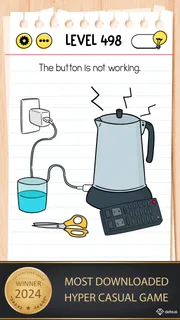
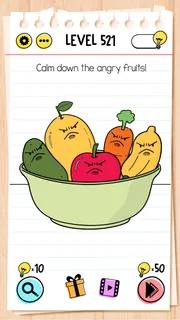
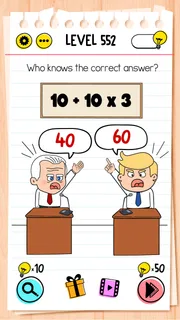
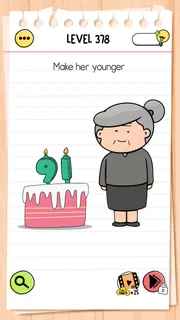
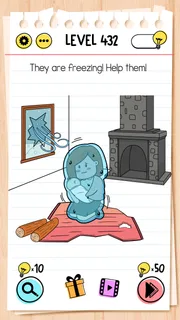
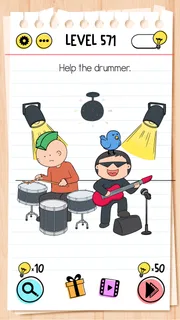
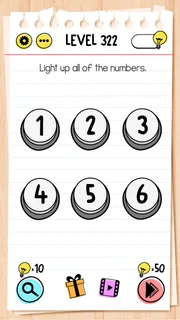
The first thing I like about the game’s approach is how it asks me to do more than recall facts. A puzzle may look straightforward, but the trick is often to reconsider what the wording or picture is asking me to do. Instead of treating every prompt like a conventional quiz, I have to observe, interpret, and sometimes challenge my first assumption. That shift is the heart of the experience.
The basic action is simple: I face a brain teaser, work out what it wants, and try a solution. The fun comes from the gap between what seems obvious and what actually works. I might start with a sensible answer, realize I have overlooked something, and then try a less conventional response. That makes each puzzle feel like a tiny conversation between the game and me: it sets up a problem, I make a guess, and the result tells me whether I understood its logic.
That style makes Brain Test: Tricky Puzzles approachable even if I am not usually drawn to trivia games. There is no need to be an expert in a particular subject to enjoy a challenge; the appeal is in thinking flexibly. I can play casually, focus on one puzzle at a time, and treat a wrong answer as a nudge to look again rather than as a serious setback.
Small puzzles, different ways of thinking
Brain teasers work best when they encourage a fresh perspective, and this game is most enjoyable when I resist rushing. A prompt may appear to call for ordinary reasoning, yet its wording or visual presentation can invite another interpretation. I find myself checking the details, reconsidering what I have taken for granted, and asking whether the puzzle expects a literal answer or a clever one.
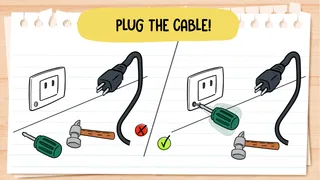
That process gives the game its personality. A conventional quiz often rewards knowing the right fact; a tricky puzzle can reward noticing the right detail. The distinction matters because it keeps the challenge accessible while still giving me a reason to pause. When I do solve one, the satisfaction comes less from showing off knowledge and more from seeing the puzzle in a new way.
A quick feedback rhythm
The loop is easy to understand: read the challenge, make a move, see the response, and decide whether to try again or continue. That immediate feedback is a major part of the appeal. If my first idea misses the mark, I can rethink it while the puzzle is still fresh in my mind. If I get it right, I can enjoy the little burst of satisfaction and move on to another problem.
More articles

Instagram Makes Everyday Moments Worth Sharing
A rare social app that can be a photo diary, a neighborhood window, and a lively conversation in the same session—though its best moments still require a little restraint.
I appreciate that this rhythm naturally supports short play sessions. The game does not ask me to settle in for a sprawling story before I can enjoy it. I can open it for a few puzzles during a break, or keep going when I am in the mood to test my problem-solving instincts. The individual challenges provide convenient stopping points, which makes the experience feel flexible rather than demanding.
There is also a useful balance between confidence and doubt. If every question were completely predictable, the game would become routine. If every answer felt arbitrary, solving anything would feel unsatisfying. The best moments are the ones where I can look back after a solution and see how the clue was pointing me in the right direction, even if I initially missed it. That sense of “I should have noticed that” is exactly what makes me want to try the next puzzle.
Wrong answers are part of the play
What I enjoy most is that an incorrect attempt can still make the session entertaining. A mistake gives me a reason to inspect the prompt again, test a different interpretation, or slow down and notice what I skipped over. The game’s tricky premise encourages experimentation instead of treating each answer as a high-stakes test. That keeps the tone light and helps the puzzles feel like playful challenges.
This approach also makes the game easy to share in spirit, even when I am playing alone. I can imagine asking someone nearby what they think the answer is, then comparing their first instinct with mine. Because the puzzles invite lateral thinking, there is room for a quick discussion about why one answer seems plausible and another might be the intended twist. It is a simple way to turn a solo brain teaser into a small social moment.
Of course, this kind of design depends on enjoying surprises. Players who prefer questions with clear, conventional answers may find some puzzles deliberately mischievous. I see that as part of the game’s identity: it is not trying to be a formal knowledge exam. It wants me to stay curious, question the setup, and accept that a clever answer can come from looking beyond the most obvious interpretation.
The reward is the “aha” moment
The main reward is the mental click when a puzzle finally makes sense. Solving a challenge feels satisfying because I have connected the clue with the right way of thinking, not simply selected an answer at random. That moment can be brief, but it gives each completed puzzle a clear payoff. The next challenge then offers a fresh chance to get that feeling again.
For me, that makes the game more compelling than a basic stream of questions. Its appeal is not only in being right; it is in discovering why the apparently simple problem was trickier than it looked. When a solution reveals a detail I overlooked, I get a small reminder to be more observant on the next one. The reward carries forward as curiosity: what will the next puzzle make me rethink?
The game has broad reach, with over 100 million installs and a 4.7 average from around 10 million ratings. Those figures suggest that its quick, accessible puzzle format has found a substantial audience. It is rated for everyone, so the light brain-teaser premise is easy to approach across age groups, though individual players will naturally differ in how much they enjoy its particular style of trick question.
Designed for easy returns
A good casual game makes returning feel natural, and this one has a straightforward reason to bring me back: there is always another small challenge to consider. I do not need to remember a complicated sequence of events to pick up where my curiosity left off. I can simply face a puzzle, make a guess, learn from the response, and see whether I can solve the next one.
That structure suits people who want a little stimulation without committing to a lengthy gaming routine. The puzzles invite attention, but the basic play pattern remains easy to grasp. I can take a break after a satisfying answer and return later when I want another mental challenge. The session does not need a grand ending; a solved puzzle is enough to make stopping feel tidy, while an unsolved one can leave me wondering what I missed.
Reset, rethink, and go again
The reset in this game is mental more than dramatic. When a solution does not work, I return to the same prompt with a different attitude. Instead of repeating the exact same assumption, I can re-read the question, inspect the presentation, and try to spot a hidden angle. That quick shift is central to the experience: the game asks me to reset my thinking, not to master a complicated control scheme.
This also explains why another session can begin so easily. I am not returning because I need a long explanation of the game’s systems; I am returning because the next puzzle promises a new little test. Each attempt offers a fresh cycle of action and feedback. A wrong answer invites another look, a correct answer gives me a reward, and the change of problem gives me a reason to continue.
As a free game, it is simple to try, while optional in-app purchases are available from $0.99 to $7.99 per item. The core appeal remains the brain-teaser loop: think, test an idea, respond to the feedback, and move on. That clarity helps the game stay approachable for casual players who want to sample a puzzle or two without first learning a lengthy set of rules.
Who is likely to enjoy it?
I would recommend it to players who like riddles, lateral-thinking questions, and short bursts of casual play. It is especially suited to anyone who enjoys being surprised by a prompt and does not mind changing course after an initial guess. If you want a trivia game centered on memorizing facts, this is a different kind of experience; its focus is on interpreting the puzzle and spotting the twist.
It can also work well as a light activity when I have a few spare minutes. The challenges give me something to focus on, but the format does not require me to turn a quick break into a major commitment. I can play at my own pace, enjoy a solution, and stop when I have had enough. That flexibility is a strong part of its everyday appeal.
My verdict on the puzzle loop
Brain Test: Tricky Puzzles succeeds when it makes me pause, reconsider, and enjoy the surprise of a solution. Its strongest feature is the tight loop between trying an answer and learning from the result. The puzzles are approachable, the feedback keeps the pace moving, and each solved challenge offers a small reward that makes another one tempting.
I would not describe it as a serious test of specialist knowledge; its charm comes from playful reasoning and unexpected interpretations. That means its humor and trickiness will suit some players more than others, but the central idea is easy to understand: do not assume the first answer is the right one. For a free trivia-style brain game rated for everyone, it offers a friendly way to exercise observation and flexible thinking.
Overall, I find it an enjoyable pick for short sessions and casual mental challenges. I can start with one puzzle, get caught by a misleading assumption, and keep going because I want to see what the next one is hiding. That action, feedback, reward, and reset cycle gives the game a clear identity—and a simple reason to return whenever I feel like testing my brain.
Pros
- Quick levels make it easy to play in short sessions.
- Creative solutions reward thinking beyond the obvious.
- Hints help players move forward when stuck.
- A wide range of puzzles keeps the gameplay varied.
- The simple controls work well on mobile devices.
Cons
- Some answers rely on unexpected wordplay.
- Hints may be limited without watching ads.
- Difficulty can vary sharply between levels.
- Ads can interrupt the flow of play.
- Repeated puzzle styles may feel familiar over time.


