
Our review
 Analysis by Lookingapps
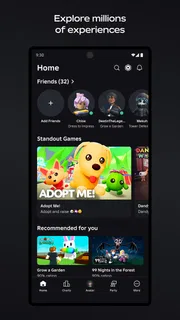
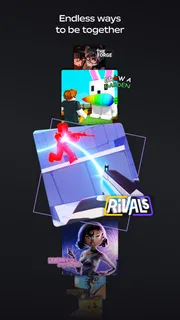
Roblox is best understood as a place to choose between many player-made experiences, rather than as one adventure with a fixed story. I find that distinction useful when deciding whether to install it: if I want to try different kinds of play without committing to a single game, it has a strong appeal. If I want one carefully paced campaign with a consistent tone, its variety can feel more scattered than satisfying.
How to decide if Roblox fits your play style
Roblox is a free adventure game from Roblox Corporation, though purchases inside the app can range from about fifty cents to nearly two hundred dollars per item. That makes “free” a fair description of getting started, but not a promise that every experience or customization choice will cost nothing. I would begin with a clear personal rule: explore first, and treat any purchase as a separate decision rather than part of the basic download.
The central question is not simply whether you like adventure games. It is whether you enjoy browsing a broad, changing collection and are comfortable with experiences that can differ greatly in style and quality. One session may be about exploring a world; another may feel closer to a social hangout, a challenge, or a role-playing scenario. That range is the main attraction, but it also means the app does not offer one uniform design standard.
The audience is broad, but the content rating is Teen, so I would not treat it as an automatic choice for every child. Families should make their own decision about age, play habits, and what kinds of online experiences feel appropriate. For a teen who likes experimenting with different kinds of games, the format can be a natural fit. For someone who prefers a tightly controlled, single-player experience, a conventional adventure title may be easier to assess.
There is a substantial audience behind the platform: it has an average rating of 4.2 from around 53 million ratings, and more than a billion installs. Those figures suggest that it has become a familiar destination for many players, but popularity alone does not tell me whether a particular experience will suit my taste. I use the scale as a reason to expect variety, not as a guarantee that every discovery will be a winner.
Why the library model is its strongest advantage
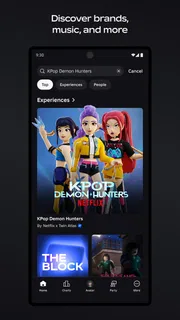
The biggest win is the ability to move between different kinds of play without changing apps. In a typical game, I learn one set of rules and stay within one world. Here, browsing is part of the activity: I can look for something that suits my mood, sample it, and switch direction if it does not click. That makes the platform especially useful for short, exploratory sessions and for players whose interests change from day to day.
A practical way to use that breadth is to search with a specific mood in mind rather than choosing the first appealing result. If I have only a few minutes, I would look for a simple experience that is easy to understand at a glance. If I have a longer session, I might try something that asks for more exploration or coordination. This small habit reduces the feeling of being lost in an endless catalogue and gives each session a purpose.
More articles

Instagram Makes Everyday Moments Worth Sharing
A rare social app that can be a photo diary, a neighborhood window, and a lively conversation in the same session—though its best moments still require a little restraint.
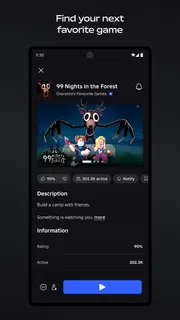
Another useful approach is to treat discovery as a process of comparison. I would try a few experiences in the same general style, then keep track mentally of which ones explain their goals clearly and which ones make me work too hard just to understand what to do. That is more effective than assuming the platform itself has one consistent level of polish. The experience you select matters as much as the app around it.
For friends or family members with different tastes, the variety can make it easier to find a shared starting point. One person may want a playful challenge while another prefers a more relaxed setting, and the platform gives them room to look for an overlap. The trade-off is that agreeing on what to play can become its own task. If the group wants a single, familiar game with a fixed set of rules, a dedicated multiplayer title may get everyone started faster.
Everyday use: fitting it into a short break
Imagine opening the app during a quiet break and wanting something more interactive than scrolling through videos. I would decide first whether I want quick action, exploration, or a social session, then browse accordingly. If the first choice feels confusing or dull, I can move on instead of forcing myself through a long introduction. That flexibility is a real strength for casual play, where the cost of a poor pick is mostly a few minutes.
There is a counterpoint: constant choice can make a short break disappear into browsing. I find the platform works better when I set a simple boundary, such as choosing one experience to try before I start. That keeps the library from becoming a distraction in its own right. Players who find menus and discovery tiring may be happier with a game that opens directly into a familiar level or ongoing story.
Because the catalogue contains distinct experiences, I would also avoid judging the entire app by one disappointing session. A weak match may reflect the particular game I selected, not the platform’s broader potential. At the same time, this flexibility asks the player to do more of the filtering. If I want the developer to curate one consistent adventure from beginning to end, this model is less dependable than a standalone release.
Where other kinds of games may be the better choice
Compared with a conventional story-driven adventure, Roblox is stronger at variety and weaker at narrative continuity. A single adventure game can give me a clear arc, a consistent visual identity, and a deliberate pace. Roblox is a better fit when I would rather browse among different ideas than follow one authored journey. The choice comes down to whether I value range or coherence more in a particular week.
Compared with a focused competitive game, it can be less direct. A competitive title typically puts its central activity front and center, while here I have to choose an experience before I know whether it delivers the kind of challenge I want. If my main goal is to practise one game mode or build skill around a stable ruleset, a dedicated game may suit me better. If I like changing the rules of the evening, Roblox has the advantage.
It is also not the best match for someone who dislikes browsing or wants a guaranteed, uniform level of refinement. Since different experiences can feel unlike one another, the quality and clarity I encounter may vary. I would recommend a traditional, curated adventure to players who want a reliable sequence of scenes and minimal decision-making. Roblox asks for more curiosity and a little patience in exchange for a wider menu of possibilities.
What to expect from spending and setup
Starting is free, but the in-app purchase range is wide, from about fifty cents to just under two hundred dollars per item. I would keep that distinction in view, especially if younger players use the app or if several people share a device. Before handing it over, agree on whether purchases are off-limits or require permission. That conversation is more useful than assuming that a free download means there will never be a spending decision.
The app is rated Teen, so I would make the age decision deliberately rather than relying on the fact that it is popular among a broad audience. Parents and guardians should consider the player’s maturity and how much guidance they want to provide. A teen who is comfortable exploring a varied game library may find plenty to enjoy; a younger child may need an adult to help decide whether it is appropriate and to establish clear boundaries around play and spending.
For device compatibility, the minimum operating system is version 8.0. The current version is 2.744.1081, and the game first released on July 15, 2014. I would check the app store on the device I plan to use before relying on it, especially if the device is older. Once installed, the most important practical step is not technical: take a moment to browse thoughtfully instead of treating the first result as the definitive Roblox experience.
Switching from another game is easy in one sense: there is no single campaign to finish before trying something else. The harder adjustment is changing expectations. In a curated game, the developers have already chosen the order and shape of the experience. Here, I take on more of the work of finding a good fit. Players who enjoy that discovery process may find it refreshing; those who want to press play and immediately know what the whole game is about may find it frustrating.
My recommendation
I recommend Roblox to curious players who like exploring different styles of play, want a library that can suit changing moods, and do not mind choosing among experiences themselves. It is particularly appealing when friends or family want to search for something they can enjoy together, or when I want a brief session that does not have to continue a long story. The huge player base and broad library make it easy to see why it has become a regular destination for so many people.
I would skip it if I wanted one polished, carefully paced adventure, disliked browsing, or needed every experience to feel consistent. I would also approach purchases thoughtfully and take the Teen rating seriously when deciding who should play. For me, the clearest way to enjoy the app is to treat it as a discovery platform: choose a mood, sample with intention, and move on when a particular experience is not working.
Overall, Roblox is most rewarding when I value choice more than certainty. Its strengths are breadth, convenience, and the freedom to shift between different kinds of play; its main friction is that the same freedom puts more responsibility on me to find the right experience. If that sounds enjoyable rather than like extra work, it is well worth trying. If I would rather have one dependable adventure with a beginning, middle, and end, I would choose a more focused game instead.
Pros
- A huge library of player-created experiences offers plenty to explore.
- Cross-platform play lets friends join from supported devices.
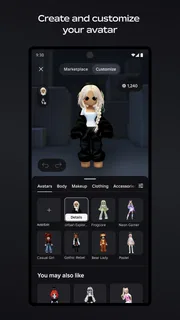
- Avatar customization gives players many ways to express themselves.
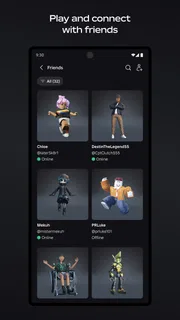
- Built-in chat and friend features make it easy to connect with others.
- Roblox Studio lets creative users build and share their own games.
Cons
- Some experiences include aggressive prompts to spend Robux.
- Chat and user-generated content may expose children to unsuitable material.
- Experience quality varies widely because games are made by users.
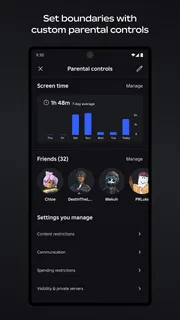
- Parental controls require attention to keep settings suited to a child.
- Performance can vary depending on the device and the experience.


