



Our review
 Analysis by Lookingapps
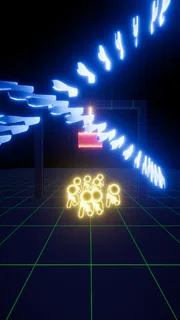
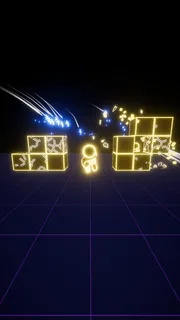
I would describe Slow Mo Strike: Knives in Time as a small, focused action game built around one clear payoff: line up a sequence of knife throws, then watch them resolve together. It is less about navigating a sprawling world than about making a deliberate mark and enjoying the brief, dramatic result. That makes it easy to understand at a glance, but the appeal depends on whether you enjoy careful tracing and compact bursts of play.
What to expect from the knife-throwing idea
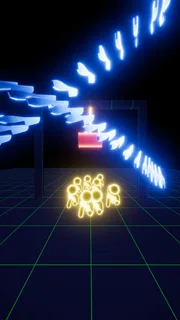
The premise is straightforward: time slows while you draw a path, and the knives follow when you release. The challenge is not simply tapping as quickly as possible. You are deciding where a whole sequence should go before seeing it play out, which gives the action a planning element unusual for a lightweight action game.
The central reward is the transition from quiet aiming to a single coordinated burst. I find that sort of delayed payoff satisfying because the preparation makes the release feel earned. If you prefer games where every second is filled with rapid movement and constant reactions, this deliberate rhythm may feel restrained. If you like quick, readable challenges with a moment of visual impact, it is a more natural fit.
The game’s concept is narrow by design. It is not the kind of action title I would choose for a long campaign, character building, or a complicated control scheme. Its strength is that you can understand the basic goal without studying a tutorial for ages. The trade-off is that a focused mechanic has to remain enjoyable through repetition; players who need frequent changes of pace may want a broader game alongside it.
Developed by KAYAC Inc., this free game is rated Teen. It has a 4.7 average from around 11,000 ratings, and more than 5 million installs. Those figures suggest that its simple premise has found an audience, but they do not tell me whether its particular rhythm will suit you. I would judge that by whether you enjoy planning a short action sequence and then seeing it unfold.
Why the pause-and-release rhythm matters
When the game gives you time to trace, it shifts attention from reflexes to intention. That can make a small success feel more personal: you chose the route rather than merely reacting to an obstacle. A useful way to approach each attempt is to trace with a clear purpose instead of drawing hurriedly just because the action is waiting.
There is also a practical difference between this and familiar action games built around continuous attacks. In a conventional arcade brawler or shooter, the fun often comes from staying active and correcting mistakes in real time. Here, the meaningful decision arrives before the release. If you enjoy pausing to plan a clean sequence, that contrast is refreshing; if you want control after the action has started, the format may feel limiting.
More articles

Instagram Makes Everyday Moments Worth Sharing
A rare social app that can be a photo diary, a neighborhood window, and a lively conversation in the same session—though its best moments still require a little restraint.
Getting started without overthinking it
On first launch, I would focus on learning the basic gesture and watching what happens after release rather than trying to make an elaborate trace immediately. The store description frames the objective around sending all 30 knives in one burst, but the useful first step is simply to see how your own path translates into the on-screen action. A modest, intentional attempt teaches more than an ambitious scribble.
There is no need to treat the opening session as a test of precision. Try to notice the relationship between the line you draw and where the knives travel. Keep the movement simple enough that you can remember what you did when the result appears. That gives you a concrete basis for adjusting your next attempt, rather than changing several things at once and guessing which change mattered.
For a first-time player, a good routine is to make one attempt, observe the result, and then alter only one part of the trace. You might change its direction or make the line more controlled, rather than redrawing everything differently. This is a small but useful way to turn a casual game into a learnable one: each release becomes feedback, not just a win-or-lose moment.
Your first meaningful success
I would count the first satisfying success as a release where the knives follow the route you intended, even if the result is not perfect. That moment confirms that you understand the central interaction. Once it happens, you can work toward the larger payoff of coordinating the full sequence, instead of assuming that the only worthwhile outcome is an immediately flawless run.
A practical tip is to keep your first trace legible. Overcomplicated lines can make it harder to tell whether a miss came from your timing, your route, or simply from trying too much at once. A clean route gives you clearer feedback. This is especially helpful if you are playing in a short break and do not want to spend several minutes reconstructing why an attempt went wrong.
When you get a result you like, pause mentally before repeating it. Remember the shape and pace of the trace, then use that as a baseline. Repeating a successful approach is more informative than improvising every time, because it helps separate a dependable technique from a lucky outcome. The game’s simple premise makes this kind of self-coaching easy to try without turning play into homework.
Common points of confusion
The most likely misunderstanding is expecting the game to behave like a standard rapid-fire action title. The slow, deliberate setup is the point, not a delay before the “real” game begins. If you keep tapping as though speed alone is the answer, you may miss the value of shaping the sequence first. I would give the tracing mechanic a few thoughtful attempts before deciding whether it clicks.
Another possible source of frustration is expecting every line to produce exactly the outcome you pictured. A drawn gesture is an instruction, but the satisfying part is seeing how the action resolves, not merely making a drawing. If the result differs from your intention, simplify your next route and compare. That approach is more useful than making a more complicated trace in response to a confusing result.
It is also worth separating “easy to start” from “endlessly varied.” The controls and goal are approachable, but a focused mechanic can become repetitive if you want a constant stream of new systems or environments. I would recommend it as a compact game to dip into, not as a substitute for a deeper action adventure. That expectation makes the narrow design easier to appreciate.
When it fits into an ordinary day
Imagine having a few minutes between errands or waiting for a friend. This is the sort of game I would open when I want a self-contained challenge rather than a session that demands a long commitment. I can make a deliberate attempt, see the burst, and stop without needing to remember a complicated story or a chain of objectives. Its premise is especially suited to short, focused play.
That same brevity can be a drawback if you are looking for something to occupy a whole commute or an evening. A broader action game may offer more variety and a stronger sense of progression. Slow Mo Strike is better for someone who likes honing one interaction and chasing a cleaner execution. It is not the right pick if your main priority is exploration, multiplayer competition, or a large set of modes.
Because it is free, trying it is a low-commitment way to see whether the central gesture works for you. I would still approach it with the right expectation: free does not automatically mean it will suit every player, and a high rating does not guarantee personal enjoyment. The key question is simple—do you like planning a short sequence and watching it resolve, or would you rather stay in constant motion?
Choosing it over other action games
Compared with a typical reflex-based arcade game, this one places more weight on the setup than on continuous input. Compared with a puzzle game, it keeps the payoff tied to an action sequence rather than a long chain of deductions. That middle ground is its identity: a little planning, a clear release, and a compact burst of movement. I would choose it when I want a tactile, visual challenge without committing to a long run.
Players who enjoy repeated attempts may get more from it than those who expect every session to introduce a new mechanic. A useful personal test is to ask whether you enjoy refining a gesture after seeing its result. If yes, the game gives you a clear loop to engage with. If you mainly enjoy unlocking new tools or exploring changing stages, a more expansive action title is likely the better choice.
Version, compatibility, and who should try it
The current version is 017, and it requires Android 5.1 or later. That makes the stated minimum operating-system requirement relatively accessible for Android users with older devices, though a compatible system alone does not guarantee that every device will feel equally comfortable to play on. For iOS readers, I would check the app store on the device they plan to use before deciding.
I would recommend it to someone who wants a free, easy-to-grasp action game, enjoys tracing a deliberate path, and values the payoff of releasing several actions together. It is also a reasonable choice for a first-time player who wants to understand the core idea quickly: make a simple attempt, observe the result, and refine one detail. The Teen age rating is worth keeping in mind when choosing games for younger players.
I would skip it if you need a story-led adventure, extensive long-term progression, or constant new challenges to hold your attention. I would also look elsewhere if slow planning feels less exciting to you than direct, continuous control. Those are not flaws that a different expectation can fix; they are signs that the game’s particular rhythm is simply not your preferred kind of action.
My take after weighing the trade-offs
Slow Mo Strike: Knives in Time has a clear hook and a sensible path for newcomers: learn the trace, watch the release, then make one focused adjustment at a time. Its best quality is the contrast between calm planning and a coordinated burst. Its main limitation is the same focus: players who need a wider range of activities may tire of repeating the central interaction.
I would give it a try if a compact action game with a planning-first feel sounds appealing. Start with a simple route and treat the first accurate release as progress, not as a warm-up you have to rush through. If the satisfaction comes from seeing your own plan play out, this is an enjoyable little game to keep within reach; if you want a fuller, constantly changing action experience, you will be happier with a different kind of title.
Pros
- Slow-motion visuals make each successful throw feel dramatic.
- Quick rounds make the game easy to play in short sessions.
- Simple controls are easy for newcomers to understand.
- Timing challenges can make repeated attempts satisfying.
- The core gameplay is easy to pick up without a tutorial.
Cons
- Precise timing may take practice to master.
- Repeated throws can make sessions feel monotonous.
- Later challenges may frustrate players seeking casual play.
- The game offers limited variety compared with broader action games.
- Frequent retries may interrupt the pace of play.


