


Our review
 Analysis by Lookingapps
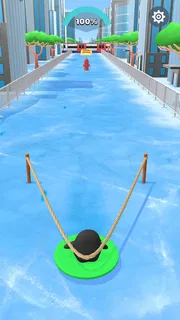
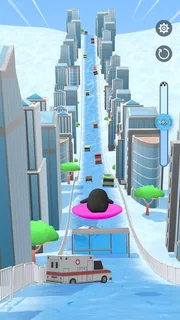
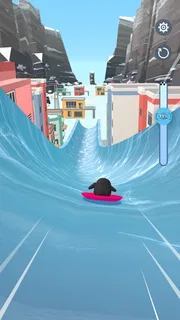
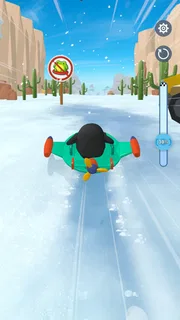
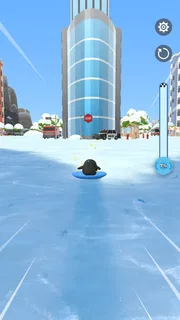
I’d describe Sled Surfers as an arcade game for short bursts of attention: you steer down snowy, icy terrain, react to obstacles, and try to keep a run going long enough to feel in control. Its appeal is immediate rather than story-driven. I found the main pleasure in reading the slope a little earlier each time and making a cleaner choice under pressure. That makes it easy to try, though not necessarily relaxing once the obstacles start demanding quick reactions.
For someone opening it for the first time, the reassuring part is that the premise is straightforward. You do not need to learn a complicated fictional world before you can play. The challenge is in the movement and timing, so a useful first goal is simply to finish a run with fewer rushed corrections than the last one. If you enjoy compact arcade sessions and like seeing your own reactions improve, this is an easy game to understand. If you want a deep campaign or a slow, scenic snowboarding simulator, it is a different sort of experience.
What to expect from a downhill arcade run
The game comes from CrazyLabs LTD and sits in the arcade category. Its central loop is built around descending a slope while avoiding hazards, with the run itself providing the immediate test. I would approach it as an action game that rewards attention more than planning a long route in advance: look ahead, decide which way to move, and avoid waiting until an obstacle is already on top of you.
That distinction matters when comparing it with familiar arcade alternatives. A basic endless runner often asks you to switch lanes or jump at a regular rhythm; a downhill setting gives those reactions a more directional, sliding feel. It is less suited to players who want a precise sports simulation, where careful control of speed and technique is the main attraction. Here, the fun is the quick decision, not recreating a real winter sport in detail.
The game is free to start, with in-app purchases listed from $0.99 to $99.99 per item. I would treat that as a reason to be deliberate rather than a reason to spend. Try the core play first and decide whether you enjoy repeating runs before considering any purchase. The broad range also makes it sensible to check the purchase screen carefully and avoid tapping through without noticing the amount.
Its audience rating is Everyone, which makes it broadly accessible as a game choice, though that does not mean every player will enjoy the pace. The game has a 4.4 average from around 286,000 ratings, and it has passed 10 million installs. Those figures suggest that the simple downhill hook has found a wide audience, but they cannot tell you whether its moment-to-moment style matches your own taste.
How I’d make the first attempt count
On a first run, I would resist the urge to chase a perfect result. Watch how the slope presents obstacles and notice whether you are reacting late, changing direction too often, or choosing a line without looking far enough ahead. That small bit of self-diagnosis is more useful than treating every crash or mistake as proof that the game is unfair. Arcade games built around fast movement can feel chaotic until you learn to scan beyond the next immediate hazard.
More articles

Instagram Makes Everyday Moments Worth Sharing
A rare social app that can be a photo diary, a neighborhood window, and a lively conversation in the same session—though its best moments still require a little restraint.
A practical tip is to focus on one improvement at a time. If you keep moving at the last moment, try making your decision when an obstacle first becomes clear. If you keep overcorrecting, make fewer changes and see whether a steadier line gives you more room to respond. These are general ways to approach the visible challenge, not secret mechanics; the value is that they turn a vague “do better” goal into something you can test on the next run.
For a first meaningful success, I would set a modest target: complete a run or reach a point that feels more controlled than your opening attempt. Once you do, repeat the same approach rather than immediately changing everything. That gives you a clearer sense of whether better anticipation helped. The game is at its most satisfying when improvement feels connected to a choice you made, rather than to random luck.
It also works naturally as a quick break between other tasks. A commute stop, a short wait, or a few minutes after finishing a chore are reasonable moments for a run-based arcade game. I would not choose it when I want something peaceful to leave running in the background, because watching the slope and responding to obstacles is the point. Nor would I start a session expecting a long, narrative experience; the draw is the repeatable challenge of the descent.
Setup, expectations, and useful checks
The current version is 1.13.2, and the listed minimum operating system is 7.1. Before installing, I would check that the device meets that requirement and leave enough attention for the first launch: this is not the sort of game where an elaborate setup strategy is needed to understand the basic premise. I would also make sure purchases are handled carefully if the device is shared, especially because optional items span a wide price range.
There is no need to make the first session a commitment. Install it, try a few runs, and decide based on whether the movement feels satisfying on your device and whether the obstacle-avoidance loop makes you want another attempt. That is a better test than judging it from a single moment of confusion. If you quickly understand how to respond but still dislike the constant urgency, the style may simply not suit you.
One common point of confusion in games like this is mistaking a failed run for a lack of progress. A run can be useful even when it ends early, because it shows which decisions are becoming automatic and which still catch you off guard. Instead of immediately restarting on autopilot, take a second to recall the last moment you felt in control. Then try to preserve that decision-making on the next attempt. This makes repetition feel like practice rather than a loop with no lesson.
Another sensible habit is to avoid judging the game by how quickly you can get a perfect result. The downhill pace encourages snap reactions, and first-time players may need a little time to read the screen comfortably. If you find yourself making frantic movements, slow your own decision process: scan farther ahead, choose a line, and only adjust when the terrain calls for it. The challenge remains fast, but your approach can be less panicked.
Who will enjoy it, and when I’d choose something else
I’d recommend giving it a try if you like arcade games that are easy to begin but still ask you to sharpen your timing. It is especially appealing if you enjoy seeing a small improvement across repeated attempts and do not mind that a run can be interrupted by a mistake. The snowy downhill theme gives the action a clear identity, rather than making it feel like a generic runner with an interchangeable backdrop.
I would steer away from it if your main goal is a realistic skiing or snowboarding experience, a substantial story, or a slow game you can play without paying close attention. Someone who prefers puzzle-solving may also find the emphasis on quick movement less rewarding. In those cases, a simulation, narrative adventure, or more deliberate arcade game would likely be a better fit than a game centered on reacting to a changing slope.
For parents and casual players, the Everyone age rating is a helpful starting point, but it is still worth considering the individual player’s comfort with fast visual action and the presence of in-app purchases. Free entry makes it easy to sample the game, while the optional spending range means I would keep purchase decisions separate from the first impression. Enjoying the descent does not require deciding to buy anything immediately.
For another practical use case, it can suit a shared-device situation when each person wants to take a brief turn and compare how they handle the same basic challenge. The useful comparison is not only who lasts longer; it can also be whether one player looks farther ahead or makes fewer unnecessary corrections. That kind of informal turn-taking works best when everyone understands that the game’s attraction is quick replay, not a long shared session with a detailed progression to follow.
My recommendation after the first few runs
My advice is to judge Sled Surfers by the feeling of its controls and the appeal of trying again, not by how polished you expect a full sports game to be. Give yourself a few runs to understand the rhythm, then focus on one change: earlier decisions, steadier steering, or better attention to what is coming next. If that makes the descent feel more manageable, you have found the core pleasure the game offers.
If you are still frustrated after that, there is no need to force it. Arcade games are personal: the same quick pace that makes this a handy little break for one person can feel repetitive or stressful to another. I see it as a lightweight choice for people who want a direct, obstacle-focused downhill challenge and are happy to improve through repetition.
Overall, I’d recommend trying it when you have a few spare minutes and want something simple to pick up, with enough action to keep your attention on the screen. Its strengths are the clear premise and the chance to make each attempt feel a little more deliberate; its trade-offs are the repetitive run-based structure, fast reactions, and optional purchases that call for care. Start free, aim for a more controlled run rather than perfection, and keep playing only if that small sense of progress is fun for you.
Pros
- Easy-to-learn controls make it approachable for casual players.
- Short runs suit quick play sessions.
- The winter setting gives the game a clear visual identity.
- Collectibles add goals beyond simply reaching the finish.
- Sled racing offers a change from typical endless runners.
Cons
- Gameplay may feel repetitive after several runs.
- Progress can depend heavily on collecting in-game rewards.
- Small obstacles may be hard to spot at speed.
- The challenge may feel uneven for new players.
- Limited variety can reduce long-term replay value.


