
Our review
 Analysis by Lookingapps
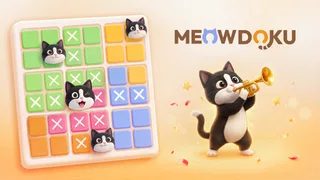
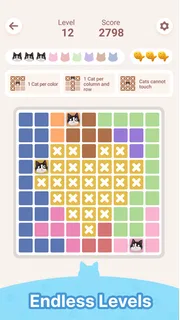
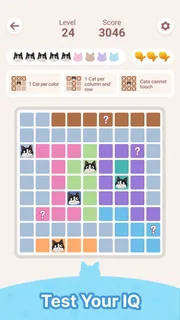
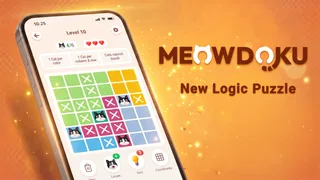
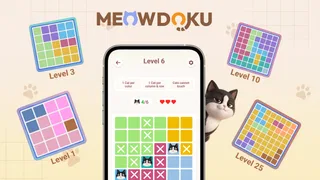
I like puzzle games that make me pause before tapping, and Meowdoku: Brain Puzzle Games has a neat way of encouraging that kind of careful thinking. It combines familiar number-grid logic with a territory puzzle built around cats, so the challenge is less about racing through a board and more about working out which spaces belong together. The result feels approachable at first glance, but it asks for more than casual guessing once the clues begin to interact.
A compact puzzle with a distinct logic
Made by Oakever Games, this free puzzle game has found a substantial audience: it has more than 10 million installs and a 4.7 average from around 546,000 ratings. Those figures suggest broad appeal, though they do not tell me whether the particular mix of Sudoku-style deduction and territory reasoning will suit you. In my view, its identity comes from that mix rather than from the cat theme alone.
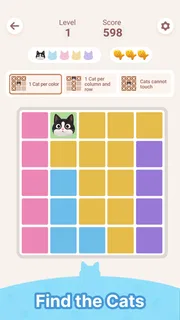
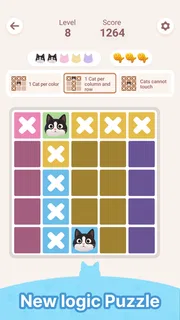
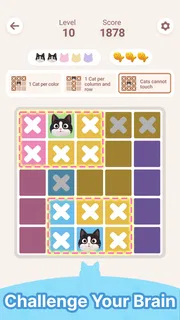
The central appeal is the shift in question. Instead of simply asking which number belongs in a cell, the game asks me to infer the boundaries of each cat’s territory. That makes every mark part of a larger picture: a choice can look plausible in isolation yet cause trouble when I consider the neighboring spaces. Players who enjoy logic puzzles will recognize the satisfaction of eliminating possibilities, but the board encourages a different rhythm from a standard Sudoku grid.
That distinction matters when choosing what to play. Traditional Sudoku is usually the better fit if you want a familiar number-placement routine, while a classic Minesweeper-style puzzle is more direct if you enjoy revealing safe spaces around hazards. Meowdoku sits between those habits. It rewards methodical deduction and spatial awareness, with a playful theme that softens the presentation without removing the need to think.
Why the combination works
The strongest part, for me, is how the two puzzle traditions can support each other. Sudoku trains you to respect constraints across a grid; Minesweeper trains you to infer what must be true from nearby clues. Here, territory boundaries give those habits a shared purpose. When I get stuck, the useful question is not merely “What can I fill in?” but “Which arrangement remains possible if I commit to this boundary?” That change in perspective can make a small board feel like a proper deduction exercise.
A practical way to approach a tricky puzzle is to avoid locking in a territory as soon as it looks likely. I first look for spaces that seem forced by the surrounding clues, then use those as anchors to narrow down the less certain edges. This is more reliable than trying to picture the entire solution at once. It also reduces the temptation to make a speculative move and then forget which later conclusions depended on it.
Another useful habit is to treat uncertainty as information. If two neighboring spaces could plausibly belong to different cats, I pause and check what each option would mean for the rest of the board. Even without writing a formal proof, comparing the consequences can reveal that one choice creates an impossible shape or conflicts with another clue. That kind of quiet, step-by-step reasoning is where the game’s design feels most satisfying.
More articles

Instagram Makes Everyday Moments Worth Sharing
A rare social app that can be a photo diary, a neighborhood window, and a lively conversation in the same session—though its best moments still require a little restraint.
The cat theme gives the logic a gentler face, which is a genuine plus if you want a puzzle that feels less austere than a bare grid. I would not choose it expecting a story-led cat game, though. The pleasure is in solving the board, and the theme is the wrapper around that activity. For me, that balance works: it adds character without distracting from the puzzle’s main job.
Where patience is required
The same deliberate logic that makes the game rewarding can also make it feel slow. If you prefer puzzles that constantly introduce new mechanics or keep you moving through a narrative, a territory grid may begin to feel repetitive. The core appeal depends on enjoying the act of narrowing down possibilities, not on frequent changes in activity. I see this as a matter of taste rather than a flaw everyone will notice, but it is the main reason I would not recommend it to every casual player.
There is also a learning curve in knowing how to read a board efficiently. Someone coming from ordinary Sudoku may initially focus too much on number-like constraints, while a Minesweeper fan may look for a simple sequence of safe and unsafe cells. Meowdoku asks you to combine those instincts and think about complete territories. If the first few puzzles do not immediately click, I would slow down and reason from the most certain spaces instead of tapping around to see what happens.
That suggests a useful trade-off for players who like to solve on a phone during short breaks: the game can suit a quick pause, but only when you are comfortable leaving a puzzle unfinished. A territory deduction may require holding several possibilities in mind, and an interruption can make it harder to remember why a particular boundary seemed necessary. I would use it for a calm coffee break or a quiet stretch of waiting, rather than when I have only a moment and want instant, disposable stimulation.
Its business model is worth keeping in view as well. The game is free to download and includes in-app purchases, with listed items ranging from $3.99 to $69.99. That does not mean a player needs to spend to enjoy the central puzzle idea, but it does mean anyone who wants to avoid optional spending should pay attention to purchase prompts and their own store settings. The range is broad enough that I would treat the free entry point and paid options as separate decisions rather than assuming every part of the experience costs nothing.
Who will enjoy solving these grids
I would recommend it to people who already like logic puzzles but want a change from filling rows, columns, and boxes. It is also a good candidate for someone who enjoys Minesweeper’s inference but wants a theme and a more structured territory problem. If you like to explain your reasoning to yourself—“this space must connect here because the alternative breaks the other clue”—the game gives that habit a clear outlet.
It may be especially satisfying for players who prefer solving without relying on speed. The appeal is not a frantic test of reflexes; it is the moment when scattered constraints click into a coherent layout. That makes it a reasonable choice for a wind-down session, provided you enjoy focused concentration. It can also work as a shared puzzle to discuss aloud: one person can suggest a possible boundary while another checks whether it fits the neighboring clues. That is a natural way to make a solo logic game feel social without changing what the puzzle asks you to do.
On the other hand, I would steer away from it if you mainly want a conventional Sudoku app with number-focused boards, or a classic Minesweeper game where each move centers on nearby counts. It is also not my pick for someone seeking a deep cat-themed adventure: the cats give the puzzle its identity, but the draw is deduction. And if you dislike having to hold competing possibilities in mind, a simpler match-style or word puzzle may feel more relaxing.
The game is rated Everyone, which makes its general presentation suitable for a broad audience. That rating does not guarantee that every child will find the reasoning easy, of course. For younger players, I would expect the best experience to come from working through the clues together rather than handing over a difficult board and expecting an immediate solution.
Getting started without guessing
For a first session, I would resist the urge to solve quickly. Scan the whole board, identify the spaces that have the fewest plausible owners, and start there. Then revisit the uncertain edges after each deduction. This simple workflow is more dependable than choosing a likely-looking territory and trying to force the rest of the grid to accommodate it.
If you reach a standstill, change the question rather than making a random move. Ask what would have to be true if one disputed space belonged to a particular cat. Follow that assumption only far enough to see whether it conflicts with the rest of the puzzle, then return to the other possibility. This small “what if” test is a practical way to make progress while preserving the logic of the solution.
It is also worth noticing when you are no longer making deductions and are merely repeating the same possibilities in your head. At that point, step back and inspect a different part of the board. A clue elsewhere may settle the boundary you were debating. This is a general puzzle-solving technique, but it fits Meowdoku particularly well because the territories are connected: progress in one area can clarify another.
The current version is 1.22.0, and it runs on Android 7.0 or later. The game was released on April 24, 2026. I mention these details because they help answer two practical questions before downloading: whether an older Android device meets the stated minimum and which version name to look for in the app store. The game is also available as a free download, so trying its basic puzzle concept does not require an upfront purchase.
My verdict
My overall impression is that Meowdoku succeeds because its central idea gives familiar logic skills a fresh target. The territory focus makes it more spatial than standard Sudoku and more structured than a typical Minesweeper round. When the clues line up, the payoff is a satisfying chain of deductions rather than a lucky guess, and that is exactly what I want from a thoughtful puzzle game.
Its limitation is equally clear: the pleasure depends on patience. Players who want rapid variety, a story, or a traditional number grid may find the format too narrow. I would also keep the in-app purchase range in mind if avoiding optional spending is important to you. Those caveats do not cancel out the game’s strengths, but they do make the audience specific.
For a friend who enjoys careful, low-pressure brain teasers and is ready to trade ordinary Sudoku routines for cat-shaped territory reasoning, I would recommend giving it a try. For someone who wants instant action or a conventional puzzle format, I would suggest choosing a different game. My recommendation is strongest for patient solvers who enjoy proving a move before making it.
Pros
- Easy-to-learn rules make it approachable for casual players.
- Short rounds suit quick play sessions.
- A fresh board layout gives each puzzle a new challenge.
- No fast reflexes are needed to solve the puzzles.
- Can provide a relaxing way to exercise logic skills.
Cons
- Some puzzles may feel repetitive over time.
- The difficulty may not satisfy experienced puzzle fans.
- Mistakes can make a board harder to complete.
- Progress may feel slow for players seeking quick rewards.
- Small puzzle pieces may be tricky to use on compact screens.


