
Our review
 Analysis by Lookingapps
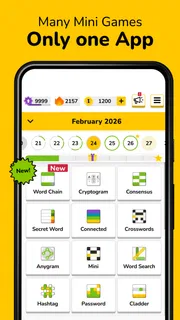
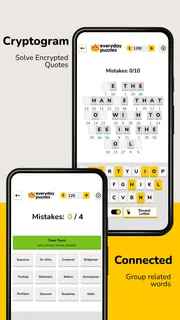
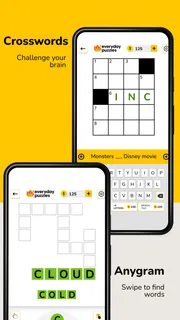
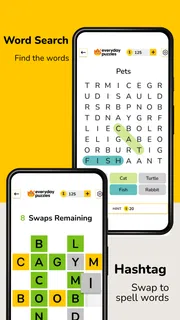
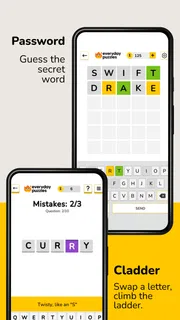
I like a puzzle game best when it gets me thinking quickly without demanding that I clear an hour in my schedule. Everyday Puzzles: Mini Games is built around that kind of casual session: it brings several word-puzzle styles together, including Hashtag, crossword and word search. Rather than committing to one format, I can choose the sort of challenge that suits my mood, which makes it a handy option for a commute, a short break, or a quiet few minutes at home.
Quick starts, with different kinds of thinking
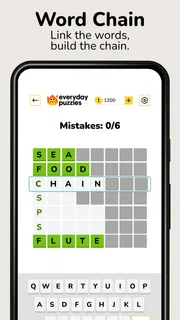
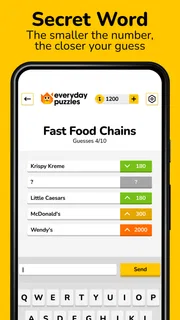
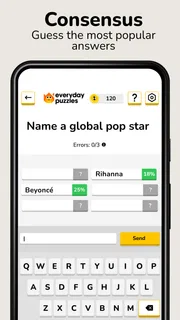
The game sits in the trivia category, but its appeal is broader than answering general-knowledge questions. The formats ask me to notice word relationships, work through clues, or scan a grid for terms. That variety matters: if a crossword clue has me stuck, switching to a word search changes the task instead of making the whole session feel like one long test.
Hashtag is the less familiar option beside the established crossword and word-search formats. It gives the collection a distinct flavor, although anyone who prefers conventional clue-solving may find themselves returning to the classics. I would treat the different modes as a choice of mental gears, not assume that every one will suit every player equally well.
The useful speed expectation is modest: this is designed for brief puzzle sessions, not for a sprawling story or a complicated game world. You can open it when you have a little time and decide which puzzle style to try. That makes it easy to fit into small gaps in the day, though it does not mean every puzzle will be solved quickly. Word games can still slow me down when a clue or pattern refuses to click.
How I would fit it into an ordinary day
Imagine waiting for a train with only a few minutes before boarding. A word search can be a straightforward way to occupy that pause, while a crossword may be better when I can give a clue a little more attention. Later, at home, I might try Hashtag for a change of pace. The value is not that each mode is automatically short; it is that having several formats in one game lets me choose a task that matches the time and concentration I have.
That variety also helps when playing with different moods, but it is not a substitute for a dedicated puzzle app if you want deep specialization. A crossword-focused alternative may be preferable if you care most about a concentrated crossword experience. Likewise, someone who wants action, a story, or competitive play should look elsewhere: the core attraction here is word-based problem-solving.
What changes when I play for longer
In a quick session, switching formats is the clearest strength. During heavier use, the main question becomes whether the range keeps the experience fresh enough for you. Moving from a grid search to clues can provide mental variety, but the underlying theme remains words and puzzles. If you tire of word challenges easily, several modes inside one app may still feel like more of the same.
More articles

Instagram Makes Everyday Moments Worth Sharing
A rare social app that can be a photo diary, a neighborhood window, and a lively conversation in the same session—though its best moments still require a little restraint.
I would also pace longer sessions around the kind of puzzle that is holding my attention. A word search is easy to pick up and scan, while clue-based play can invite more deliberate thought. Rather than forcing myself through a mode that is not clicking, I can switch to another format or stop and return later. That simple choice is a practical way to avoid turning a relaxing break into a frustrating one.
For a household or a shared device, the different formats can make the game easier to recommend to people with different puzzle habits. One person may gravitate toward crosswords; another may prefer searching a grid. Still, this is a collection of word games, not a broad family game night package, so it is best suited to people who enjoy solving language puzzles in the first place.
Reliability and the feel of a session
I judge a lightweight puzzle game by whether it lets me focus on the puzzle rather than fight the interface. Everyday Puzzles is meant to move between familiar word formats, and that basic arrangement is easy to understand. I would not mistake a simple setup for a guarantee that every session will be perfect, but the game’s straightforward premise makes it approachable for someone who wants to get to a puzzle without first learning an elaborate system.
One practical habit is to choose a mode before settling into a longer break. If I have only a moment, I can select a format that feels easy to leave; if I have more time, I can give clue-solving a proper try. This is less about a hidden mechanic than about using the game’s variety deliberately. It makes the collection more useful than opening it at random and hoping the first challenge fits my available attention.
When a puzzle feels difficult, changing modes is also a sensible recovery strategy. It gives me a fresh task without needing to abandon the app entirely. On the other hand, players who want a carefully guided learning curve or detailed instruction for every puzzle type may prefer a specialist title that puts one format front and center. Everyday Puzzles is most appealing when you already know you enjoy word games and want options at hand.
Device fit, cost, and who should try it
Fanatee, Inc. develops the game, which is free to download and rated for Everyone. Its current version is 13.8.0, and it requires Android 7.0 or later. Those details make it relevant to people using older compatible Android devices, although a minimum operating-system requirement alone does not tell me how an individual phone will handle a particular session. I would keep expectations sensible on an older device and judge the experience in normal use rather than assume that every handset behaves alike.
The game has a 4.6 average from around 95,000 ratings, alongside more than 2.8 thousand written reviews and over 10 million installs. Those figures suggest that it has found a sizable audience, but popularity is not a promise that its puzzle mix will match your taste. I would use them as context, then decide based on whether you actually enjoy moving among word-search, crossword and Hashtag challenges.
Although the app is free, it offers in-app purchases priced from $0.99 to $49.99 per item. I would check the purchase options in the app store before spending, especially if I am installing it for a child or prefer to keep casual games entirely free. The age rating is Everyone, but that is not the same thing as a guarantee that every purchase choice will suit every family’s preferences.
This is a good fit for someone who wants a compact selection of word puzzles, likes changing the kind of thinking involved, and is happy to play in short, self-directed sessions. I would be less likely to recommend it to someone looking for a deep single-mode crossword tool, a fast reflex game, or a game that depends on a strong narrative. Its best use is as an accessible word-puzzle pick-up, not an all-purpose entertainment app.
My performance verdict
Everyday Puzzles earns its place through convenience and variety rather than technical spectacle. The game gives me several familiar ways to engage with words, and that makes it easier to match a puzzle to the moment. Its lighter, pick-up-and-play structure suits everyday breaks, while the option to switch formats can help when one kind of challenge stops being enjoyable.
My recommendation is conditional but positive: try it if crosswords, word searches, and related word challenges already appeal to you, and you want them collected in one free game. Keep in mind that purchases are available, and that variety does not eliminate the limits of a word-focused collection. For a specialist crossword experience or a completely different kind of game, another option will serve you better. For casual puzzle time, though, Everyday Puzzles: Mini Games is an inviting choice that is easy to understand and flexible enough for different short sessions.
Pros
- Quick rounds make it easy to play during short breaks.
- The mix of puzzle formats helps keep daily play fresh.
- Simple controls make the games easy to pick up.
- Daily challenges provide a clear reason to return.
- Many puzzles can be enjoyed without advanced gaming skills.
Cons
- Some puzzle types may feel repetitive after regular play.
- Difficulty can vary noticeably between mini games.
- Timed challenges may frustrate players who prefer a relaxed pace.
- Hints or extra attempts may be limited.
- Frequent play can depend on an internet connection.


