
Our review
 Analysis by Lookingapps
I found Bus Fever Party! most appealing as a small, focused puzzle: it asks you to untangle a crowded bus-and-traffic situation rather than learn a sprawling game world. That narrow premise makes it easy to understand at a glance, but it also puts a lot of weight on whether the board is comfortable to read and whether the moves feel manageable. My impression is that it suits players who enjoy visual sorting puzzles and short bursts of problem-solving, though it is less compelling if you want a story, varied activities, or a game built around accessibility controls.
Reading the board and finding your way around
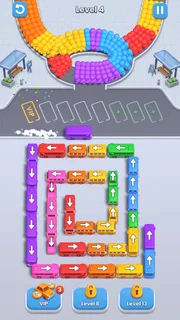
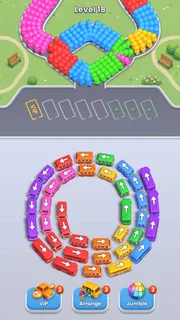
The central task is to clear a parking jam so a bus can leave. That gives each puzzle an immediately recognizable goal: inspect what is blocking the way, work out which vehicles need to move, and make room for the bus. I like that the basic idea does not require much explanation. A casual game should let a player understand the challenge before asking them to invest much time, and this one has a straightforward visual premise.
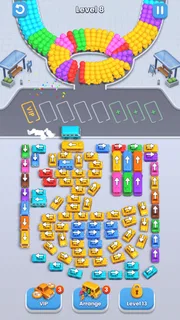
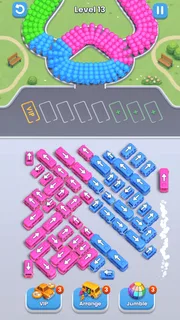
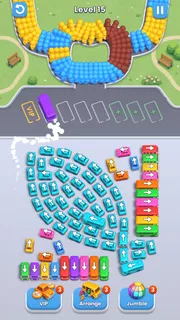
The simplicity of the objective does not mean every board is instantly obvious. Traffic puzzles ask you to scan positions and relationships: which vehicle is in the route, which movement might free another, and whether a seemingly useful move only shifts the blockage. I found that this sort of layout rewards taking a moment to inspect the whole scene instead of tapping at the first vehicle that looks movable. If you tend to overlook details in crowded pictures, that deliberate approach can be more comfortable than trying to solve the board quickly.
The game is a casual title from Lumi Games, and its popularity suggests that the basic traffic-jam idea has found a sizeable audience. It has an average rating of 4.1 from around 55,000 ratings, with roughly 1,100 written reviews and over 10 million installs. Those figures are useful context, but they do not tell me whether the game will suit a particular player’s eyesight, dexterity, or tolerance for visual clutter. I would treat the puzzle itself—not its audience size—as the deciding factor.
One practical way to approach a difficult board is to pause before moving anything and trace the bus’s exit route with your eyes. Then look for the vehicle that must move first, rather than the one that seems easiest to shift. This changes the puzzle from random experimentation into a small planning exercise. It is especially useful when a board feels crowded, because a move that creates space in one corner may do nothing for the actual exit.
Simple rules, but a visual-first experience
The game’s premise depends on reading a traffic arrangement, so visual clarity is central to the experience. That can work well for players who enjoy scanning shapes and planning from a board. It may be less comfortable for someone who has difficulty distinguishing vehicles in a busy scene or who needs larger text and strong contrast to follow game elements. I would not assume that a simple objective automatically makes a puzzle easy to perceive.
For navigation, I value games that make the next action feel obvious without requiring a long tutorial. Here, the task itself offers a natural anchor: the bus needs a way out. Still, the challenge is not only knowing what the goal is; it is understanding which pieces can move and what each move will change. If you prefer instructions that spell out every rule, or if you rely on spoken guidance rather than visual observation, this kind of puzzle may demand more interpretation than you want from a quick casual game.
More articles

Instagram Makes Everyday Moments Worth Sharing
A rare social app that can be a photo diary, a neighborhood window, and a lively conversation in the same session—though its best moments still require a little restraint.
My recommendation for a first session is to play when you can give the board your attention rather than while rushing between tasks. Try a few deliberate moves and notice whether you can follow the consequences comfortably. A player who can inspect a static puzzle at their own pace may find the format approachable; someone who needs the game to narrate the board or make its relationships explicit may find the same design less welcoming.
Motor effort and sensory comfort
A traffic puzzle generally asks for precise selection and movement, not complicated combinations of controls. That makes the concept easier to approach than an action game that expects rapid reactions, but it does not remove motor demands. If tapping small or closely arranged objects is difficult, or if repeated touch gestures cause discomfort, a board with several vehicles can still be tiring. I would avoid treating “casual” as a guarantee that every interaction is physically effortless.
The best way to judge that trade-off is to test a short session with your usual device grip and screen orientation. Notice whether selecting a vehicle feels reliable and whether you can make a move without straining your hand. If accidental selections interrupt your thinking, the puzzle can become frustrating even when the logic is within reach. In that situation, a game controlled with larger buttons, a cursor, or a different input method may be a better fit.
Sensory comfort is another personal consideration. The game’s traffic setting gives the board a visually busy subject, and some players enjoy that concrete, colorful puzzle language while others prefer spare shapes on a plain background. I would choose a quiet moment to try it if visual density or motion tends to overwhelm you. If the presentation feels tiring, that is a valid reason to stop rather than push through just because the rules are simple.
One useful habit is to separate observation from action: first identify the route and likely blockers, then make one move and reassess. This reduces unnecessary tapping and can make a puzzle feel calmer. It also helps players who need extra time to process a board, because there is no need to turn every decision into a quick reaction. The appeal here is thoughtful rearrangement, not speed as the main skill.
Where it fits into an ordinary day
I can see this game working as a brief mental break while waiting for an appointment or settling down after a busy stretch. The premise is easy to return to: look at the traffic, work out what is preventing the bus from leaving, and try a sensible move. In a realistic everyday situation, I would open it during a quiet part of a commute or while waiting for someone, then stop when I reach my destination. It is better suited to those small pauses than to a session where I want a long narrative or a strong sense of progression.
That same situational flexibility has limits. If you are playing in bright sunlight, on a very small screen, or in a setting where you cannot focus on a visual puzzle, the board may be harder to read. If you are distracted by conversation or need to keep your attention on your surroundings, this is not the sort of game I would recommend playing while moving through a crowded place. A puzzle that asks you to inspect vehicle positions deserves a reasonably stable moment.
Compared with many casual alternatives, the traffic-jam format is more about spatial reasoning than matching colors, tending a virtual space, or reacting to a stream of objects. That makes it a good choice when you want to think through a contained problem rather than maintain a long-running routine. On the other hand, players who prefer audio-led play, low-detail boards, or social activity may be better served by another kind of casual game. The particular strength here is the satisfying logic of clearing a route, not broad variety.
Costs, suitability, and practical limits
The game is free to download, with in-app purchases listed from $1.99 to $99.99 per item. I would keep that range in mind before making any purchase and check the item details in the app store rather than assuming that every option is necessary. A free starting point makes it easy to see whether the puzzle style suits you, but players who are cautious about spending should be deliberate around purchase prompts and use their device’s spending controls if needed.
It is rated for Everyone, which makes the theme broadly approachable, but that should not be confused with a guarantee that every child or adult will find the interface comfortable. The game is currently at version 1.2.9 and requires Android 8.0 or later. Those details matter when deciding whether an existing device can run it, especially if you are setting it up for someone else. It was released on April 23, 2025, so it is a relatively recent option within the casual puzzle space.
One limitation I would keep in view is that a single core idea can become repetitive if you want frequent changes in activity. The parking-jam puzzle may be engaging when you are in the mood to reason about blocked routes, but it is not an obvious match for someone who wants a varied campaign or a strong social layer. I would also skip it if the visual layout is hard for you to parse or if precise touch interaction is uncomfortable; the basic concept does not erase those barriers.
Another trade-off is that puzzle difficulty can feel personal. A board that looks pleasantly challenging to one player may feel visually confusing or needlessly fiddly to another. When you get stuck, I recommend returning to the bus’s route and asking which obstruction must move before anything else can change. If that kind of step-by-step deduction feels satisfying, the game is doing its job. If you would rather receive clear hints or have a broader set of ways to approach a problem, a different puzzle format may suit you better.
Who I would recommend it to
Bus Fever Party! is a sensible pick for someone who likes compact traffic puzzles, enjoys planning several moves ahead, and wants a casual game that can fit into a short break. Lumi Games has built its appeal around a goal that is easy to explain but can still invite careful thought. I would recommend trying it if you enjoy rearranging a crowded scene until a route opens, rather than if you are looking for fast action or extensive world-building.
For players with different access needs, I would approach it as a personal trial rather than assume it will work for everyone. The visual premise may be intuitive for some and difficult for others; the touch interaction may feel light to one person and awkward to another. There is no shame in choosing a puzzle with clearer controls or a less crowded presentation if that better supports your comfort. The right casual game is the one you can actually enjoy using, not simply the one with the easiest-sounding objective.
Overall, I see this as a focused, approachable traffic puzzle with a clear use case: a short stretch of visual problem-solving when you have enough attention to study the board. Its 4.1 average rating and large install base make it a well-established choice for this niche, but the most important question is whether its visual and touch-based style suits you. I would give it a try if parking-grid logic sounds fun, keep purchases intentional, and move on to another casual game if the board feels tiring rather than satisfying.
Pros
- Easy-to-learn controls make it accessible to casual players.
- Short levels suit quick play sessions.
- Colorful visuals give the game a cheerful style.
- Traffic puzzles reward careful planning.
- The party theme adds a playful touch to each level.
Cons
- Later levels may feel repetitive.
- Some puzzles can be frustrating without trial and error.
- The gameplay offers limited variety.
- Ads may interrupt the experience.
- Progress can feel slow for players seeking a challenge.


