







Our review
 Analysis by Lookingapps
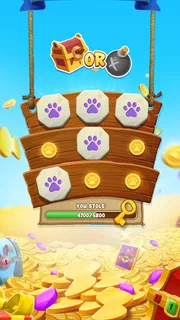
I can see Animals & Coins working best as a casual game that fits into the gaps of a shared day: a short break while someone else uses the television, a few minutes waiting for a ride, or a turn passed between people at home. Its adventure setup centers on visiting treasure islands, gathering coins, and making progress through playful animal-themed surroundings. That gives it a clearer identity than a plain coin counter, though the appeal still depends on enjoying repeated, lightweight game sessions.
How it fits into a shared day
In my experience, this kind of game is easiest to enjoy when nobody expects a long, uninterrupted session. One person can make a little progress, hand over the device, and let someone else take a turn later. The island-and-treasure framing gives each visit a simple purpose, so it is easy to understand what the game is about without asking another player to explain a complicated strategy.
That simplicity also makes it suitable for a household where people have different levels of gaming experience. A casual player can focus on the immediate loop of exploring and collecting, while someone who likes keeping track of progress can take a more deliberate approach. I would not treat it as a cooperative family activity, though: sharing a screen or taking turns is different from playing together, and the game should not be mistaken for a dedicated multiplayer party experience.
A practical routine is to agree whose turn it is before opening the game, especially if several people use one device. That avoids the awkward moment when someone makes progress on another person’s session. If the device is personal, I would keep play tied to that owner’s account and avoid casually handing it around without checking what is signed in. Those are ordinary shared-device habits, not special game controls.
What the adventure loop feels like
The central draw is the steady sense of moving from one treasure-filled setting to another. Rather than asking players to learn a deep combat system or master precise controls, the game leans on accessible progression and collecting. I find that approach welcoming when I want a light diversion, but it can become repetitive if I am looking for a story with substantial choices or a challenge that depends on technical skill.
The animal theme helps keep the presentation warm and approachable. It softens the treasure-raiding premise and gives the adventure a friendly tone, which is useful when a game might be shared with younger players. The trade-off is that anyone seeking a serious, expansive adventure may find the experience more about returning for small bursts of progress than about exploring a richly developed world.
Compared with typical puzzle adventures, this one puts less emphasis on solving a sequence of self-contained brainteasers. Compared with action games, it asks less of reflexes and sustained attention. That makes it a reasonable choice for someone who wants a low-pressure mobile game, but not the best alternative for a player who wants intricate puzzles, a strong narrative campaign, or demanding skill-based play.
More articles

Instagram Makes Everyday Moments Worth Sharing
A rare social app that can be a photo diary, a neighborhood window, and a lively conversation in the same session—though its best moments still require a little restraint.
Keeping turns and accounts clear
For a shared device, the most useful boundary is deciding whether the game belongs to one person or is being used as a communal pastime. If one person is invested in their progress, I would not let others make changes simply because the phone or tablet is nearby. If the household wants to take turns, set that expectation openly and avoid assuming that separate people will automatically have separate progress or profiles.
This is also a good game to keep out of a rushed handoff. Before passing the device to a child or another household member, I would check that the right account is active and that the person knows whether any purchases can be made through the device’s app-store settings. The game is free to start, but it includes in-app purchases ranging from $0.99 to $299.99 per item. That wide range makes purchase boundaries worth discussing in advance, rather than relying on a player to infer them while tapping through the game.
My practical tip is to treat purchases as an adult decision unless the account holder has deliberately arranged otherwise. This is not a claim about specific parental tools in the game; it is a sensible device-level habit. A shared tablet can blur the line between “my game” and “our game,” so clear ownership and payment expectations matter more than the convenience of passing the screen around.
Who is likely to enjoy it—and who may not
I would recommend it to players who like collecting, uncomplicated progression, and an adventure theme that is easy to pick up again after a break. It also suits someone looking for a game that does not require a full evening of attention. The app is free, and its Everyone age rating makes it broadly accessible as a starting point for a family conversation about whether the play style and purchase options suit a particular child.
That age rating is not a substitute for adult judgment. Younger players may need help understanding optional purchases, and a family sharing a device should decide who is allowed to spend money before play begins. For older children, I would also consider whether the repeated progression loop is a good fit for their screen-time routine. The game’s friendly presentation does not remove the need for ordinary supervision around devices and spending.
I would skip it if I wanted a complete, story-led adventure with a clear endpoint, or if I dislike games that encourage returning to collect more and continue progressing. Players who prefer highly strategic planning may also find its approachable loop too light. In those cases, a puzzle game with distinct levels or a narrative adventure built around authored chapters would be a better match.
Trust, scale, and what to expect
Innplay Labs developed the game, which was released on May 13, 2021. It has reached over 10 million installs, with an average rating of 4.9 from around 1.1 million ratings and about 37,000 written reviews. Those figures suggest that it has found a large audience, but they do not tell me whether its particular rhythm will suit someone who prefers a more substantial adventure. I would use them as a sign of broad appeal, not as a promise that every household will enjoy it.
The current version is 17.4.3, and the listed minimum operating-system requirement is 7.1. The age classification is Everyone. These details help when deciding whether an older device or a younger player is a reasonable fit, but compatibility alone does not settle the more personal questions: whether the device owner is comfortable sharing progress, whether purchases are restricted appropriately, and whether the game’s pace feels enjoyable rather than distracting.
One useful way to test the fit is to watch how a player responds after a short session. If they enjoy the small goal of making progress and are happy to put the device down afterward, the game may work well as a casual household option. If they become frustrated by interruptions or treat every turn as a race to advance, it may be better kept as an individual game rather than passed around.
A household verdict
Animals & Coins is a pleasant choice for a household that wants an approachable mobile adventure, provided everyone understands whose progress they are using and how purchases are handled. I like its easy-to-grasp treasure-and-island premise and the way it can fit into short breaks. I am less convinced by it as a shared game for people who expect direct teamwork, separate household profiles, or a deep campaign; those expectations are better served by a different kind of title.
For a parent or device owner, my recommendation is simple: try it on the account that will actually be used, establish turn-taking before sharing, and decide in advance whether spending is allowed. For an individual player, the same advice is less about household rules and more about knowing what keeps the game enjoyable. If collecting and gradual progress are satisfying to you, it is an easy game to revisit. If you need a strong story or a fresh challenge in every session, I would look elsewhere.
Pros
- Animal companions add personality to the island adventure.
- Coin collection gives each raid a clear reward.
- Island upgrades provide steady goals for progression.
- Short activities suit quick play sessions.
- Bright visuals make locations easy to recognize.
Cons
- Progress can slow when upgrade costs rise.
- Random raid outcomes may frustrate careful planners.
- Frequent play may be needed to collect enough coins.
- Events can add pressure to check in regularly.
- Some players may find the gameplay repetitive over time.


